

Male Facelift in Iran | Differences & Results
Face lift service page: This is educational content. For consultation and booking, start at the face lift service page.
A facelift corrects some age-related changes in the face and neck. In men, the surgical principles are similar, but incision design, soft-tissue handling, and desired outcome must match the individual patient’s features.
In a male facelift, preserving facial identity matters. The goal is not simply a tighter look, but correcting tissue descent while keeping natural proportions, jawline, neck contour, and masculine features.
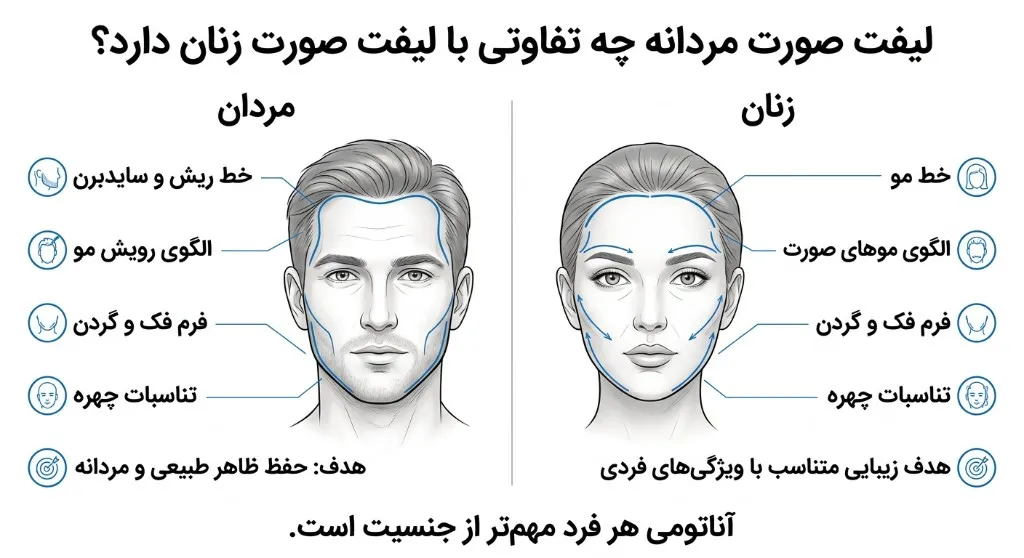
How does a male facelift differ from a female facelift?
The core operation is similar, but planning can differ. Individual anatomy, beard and sideburn patterns, hairline, facial proportions, soft-tissue quality, and aesthetic goals affect incision design and technique. For male patients, the aim is a natural masculine appearance—not a feminine or over-pulled look.
 0:17
0:17Male Facelift
Male Facelift
Key differences in male facelift planning: hairline, jawline angles, and masculine aesthetics.
“Male facelift” is not a separate single technique. The difference is evaluation and execution tailored to each patient.
Educational note: Facelift planning principles and male-specific considerations are discussed in educational materials from the American Society of Plastic Surgeons (ASPS).
What does a male facelift correct?
It mainly addresses sagging of mid and lower facial soft tissues and, in some patients, the neck. Depending on the individual, improvement may include cheek and lower-face descent, jawline definition, jowls, neck laxity, and the chin–neck angle. It is not designed to erase every fine wrinkle, change bone structure, or stop aging.
Why is planning especially important in men?
Incisions and skin redraping must respect hair-bearing skin, the beard line, and sideburns. Shifting hair-bearing skin to an unnatural position can change the beard or preauricular appearance. Men also differ widely from each other; gender alone is not enough to choose a technique.
Is there a best age for a male facelift?
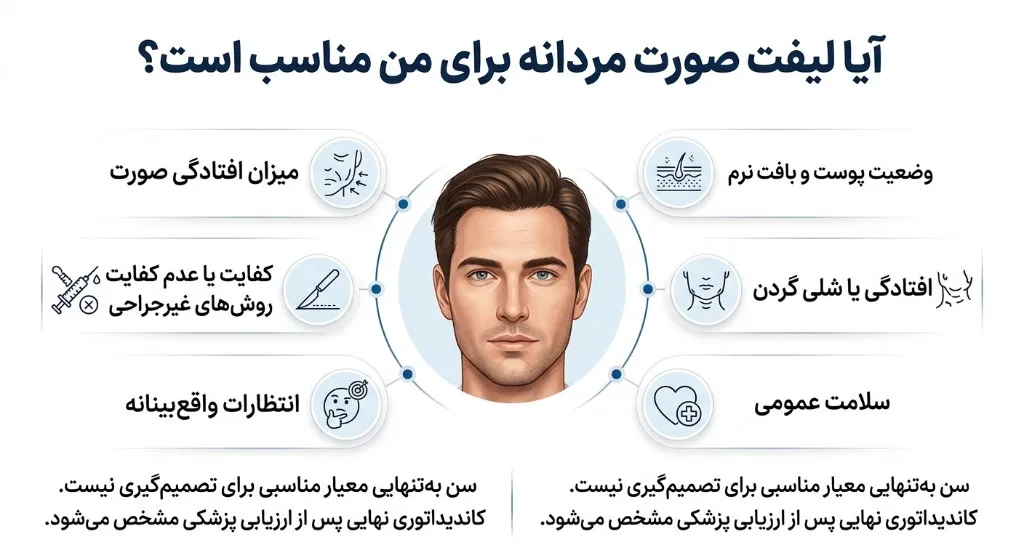
No single age fits everyone. What matters is the degree and location of laxity, tissue quality, general health, and realistic expectations. See also best age for a facelift.
Who may be a candidate?
Candidacy is determined after medical evaluation: facial and neck laxity, soft-tissue quality, general health, medications, smoking, expectations, recovery ability, and whether non-surgical options can reasonably meet the need.
Which technique is best for men?
No technique is best for every man. Choice depends on anatomy and goals.
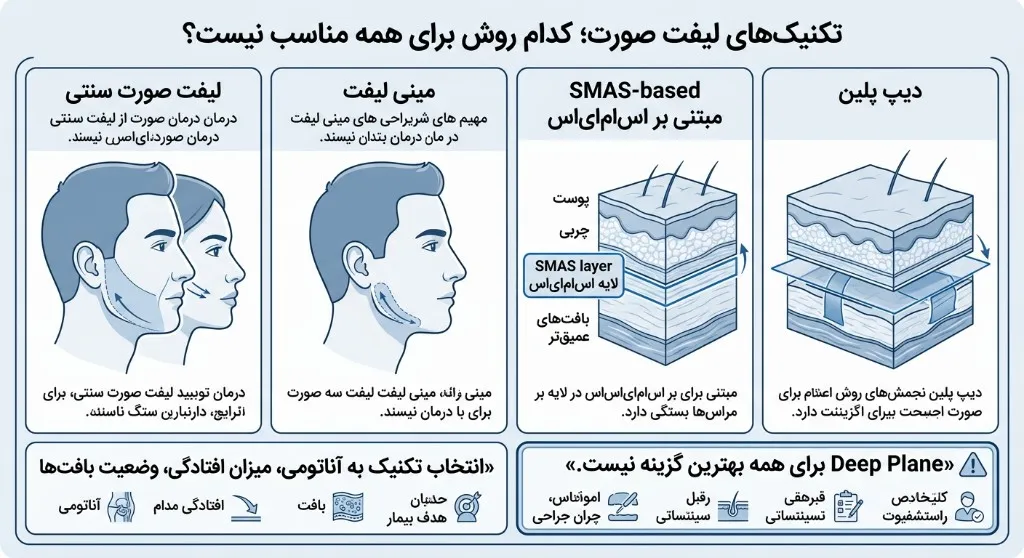
Traditional facelift, mini facelift, SMAS-based approaches, Deep Plane, and neck lift are options with different scopes. Deep Plane is one technique—not automatically superior. See also mini vs full facelift.
| Method | Often considered when | Key note |
|---|---|---|
| Traditional facelift | More noticeable face (and sometimes neck) laxity | Extent follows anatomy |
| Mini Facelift | More limited laxity | Smaller incision ≠ best for everyone |
| SMAS-based | Deeper soft-tissue support work | Execution varies |
| Deep Plane | Selected descent patterns | Not best for all men |
| Neck Lift | Neck and jawline concerns | May be combined with facelift |
Keeping a natural masculine look
Natural results depend more on matching the plan to anatomy than on a technique name. Planning may address proportions, avoiding excessive skin tension, deep tissue repositioning, jaw/neck form, beard and sideburn pattern, and incision design.
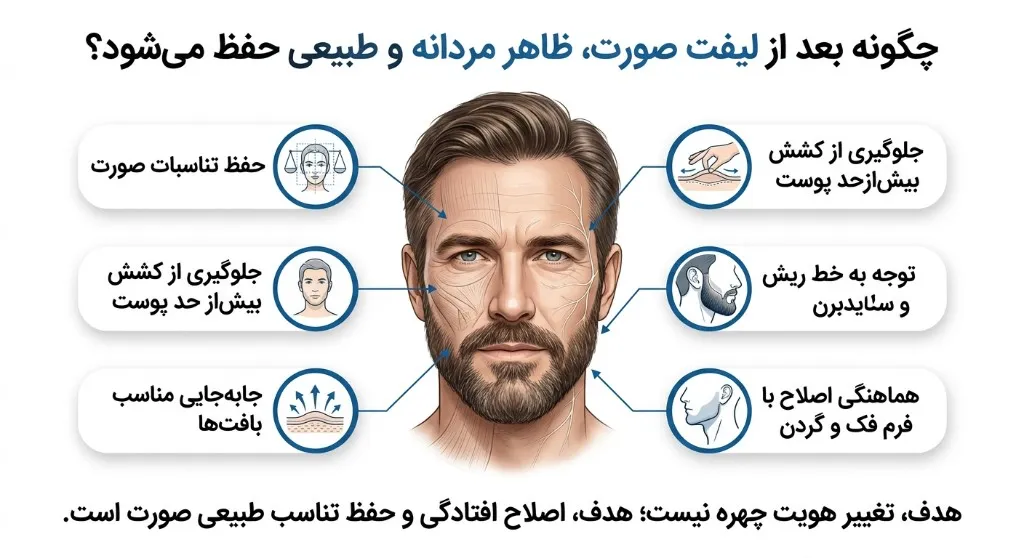
No surgery can guarantee an invisible result or zero risk.
Scars, beard line, and shaving
Scars may be visible; design aims for natural, less conspicuous paths. In men, hair pattern changes can matter as much as the scar itself.
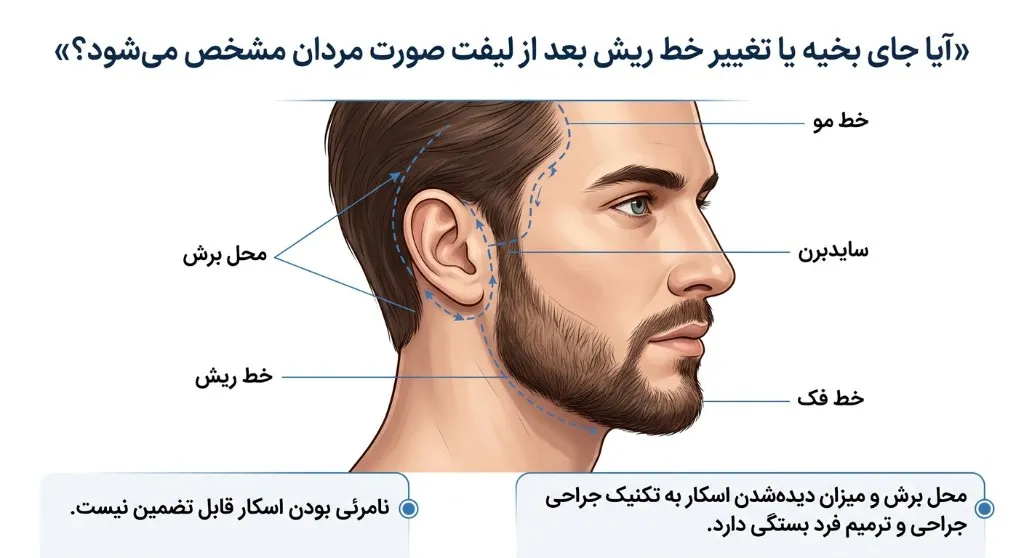
Beard growth after surgery is usually not a problem by itself; timing and method of shaving depend on wound healing and must follow the surgeon’s instructions—not a fixed calendar for everyone.
Results and longevity
Expected results are reduced laxity and improved contour—not stopping aging or a total facial change. Longevity has no single fixed number for all patients. Claims such as “exactly 7–12 years” or “exactly X years younger” are not generalizable.
Recovery, pain, and activity
Recovery stages vary with surgical extent, technique, combined neck surgery, and individual healing.
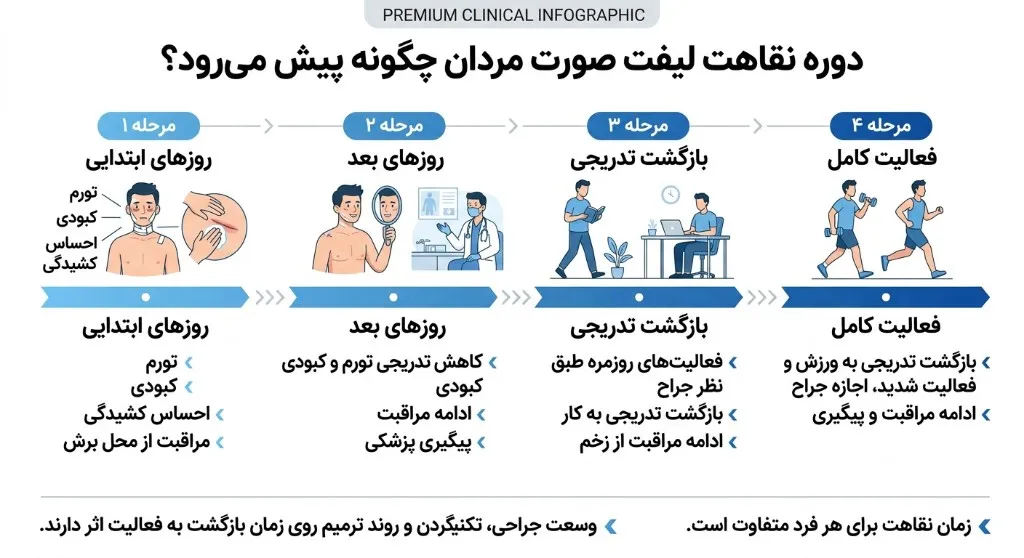
Return to work, social activity, exercise, sleep position, and shaving timing should follow the surgeon—not fixed one-size timelines. See recovery timeline and facelift pain.
Smoking, medical conditions, and risks
Smoking can impair healing; disclose use honestly. Medical conditions and medications that affect bleeding or healing must be discussed. See facelift with diabetes/hypertension and risks and complications.
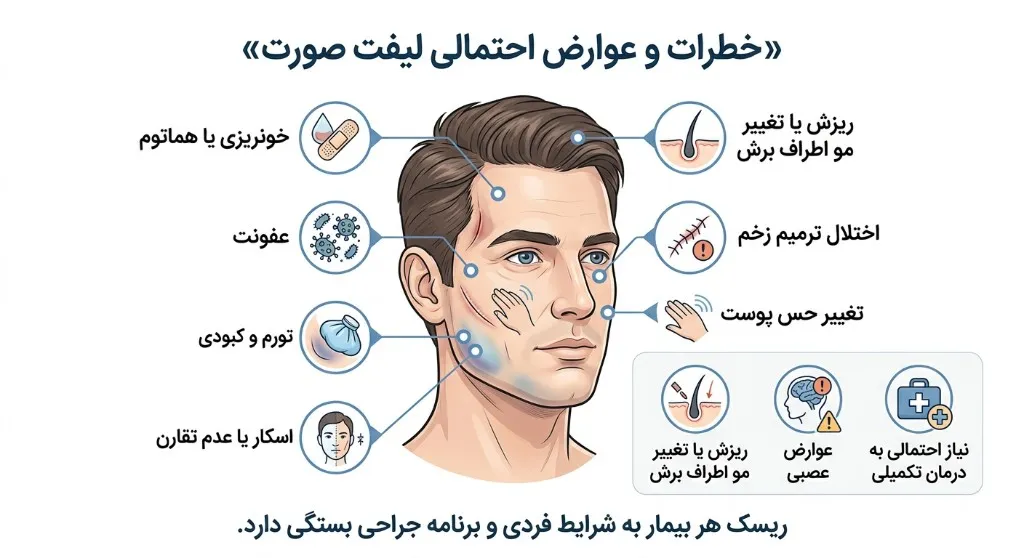
Possible risks include hematoma, infection, prolonged swelling/bruising, sensory changes, delayed healing, unfavorable scars, asymmetry, hair changes near incisions, beard-line shifts, nerve injury (important but uncommon), fluid collections, and possible need for further treatment.
Combining with neck lift, cost, and choosing a surgeon
Face and neck can be combined when anatomy and goals support it—not automatically for everyone. Cost is not a single fixed fee; see facelift cost. For surgeon selection criteria, see choosing a facelift surgeon, the doctor page, and gallery.

Warning signs include guaranteed-result promises, unverifiable “best surgeon” claims, downplaying risks, pressure to decide immediately, unclear portfolios, opaque pricing, no follow-up plan, and claims that one technique is best for everyone.
Summary
A male facelift may help correct facial (and sometimes neck) laxity and improve jawline definition while preserving identity. Technique, timing, and extent require examination. If you want an individual assessment, book a consultation or see the face lift FAQ.
Medical review: Educational content only—not a substitute for examination, diagnosis, a personal plan, or informed consent. Reviewer: Dr. Parsa Cheraghipour, ENT and head & neck surgeon.
Frequently Asked Questions
Is male facelift painful?
During the procedure, the patient is under general anesthesia or deep sedation and feels no pain. After surgery, pain is usually mild to moderate and controllable with standard pain medication.
Will facelift scars be visible in men?
A skilled surgeon places incisions in natural folds around the ear and within the hairline if needed. Over time (usually 6 to 12 months), scars fade significantly.
How long does a male facelift take and are results lasting?
The procedure takes 2 to 5 hours depending on type and extent. Results typically last 7 to 12 years, although natural aging continues.
Can I combine a facelift with other procedures?
Yes, many men combine a facelift with chin liposuction, fat injection, blepharoplasty, or skin laser treatments.
Can I grow a beard after a facelift?
Yes, after full recovery (usually 2 to 3 months) natural beard growth continues normally.