

How to Choose the Best Facelift Surgeon: 5 Key Tips
Face lift service page: This is educational content. For clinic procedure details, a post-exam cost estimate, and booking a consultation, go to face lift in Tehran.
Choosing a surgeon for a facelift is not just comparing names or prices. A facelift is a complex operation on facial and neck structures, and the outcome depends on proper patient assessment, anatomy knowledge, technique selection, safe execution, and aftercare.
If you are looking for a suitable facelift surgeon in Tehran, compare clear, verifiable criteria rather than searching only for the label “best surgeon.”
How should you choose the best facelift surgeon?
The best facelift surgeon is not the same for everyone. Check professional specialty and credentials, real experience with facial surgery, the quality and authenticity of before-and-after cases, how you are evaluated in consultation, and the proposed plan. Then review surgical safety, the facility, anesthesia, follow-up care, and cost transparency.
5 main criteria for choosing a facelift surgeon
These five criteria are the most useful for comparing options:
| Criterion | What to check |
|---|---|
| 1. Specialty and professional credentials | Specialty field, related training, and professional standing |
| 2. Real facelift experience | Similar cases and familiarity with diverse patient conditions |
| 3. Real case portfolios | Quality, variety, photography conditions, and reliability of images |
| 4. Consultation and treatment plan | Examination, technique explanation, expectations, and answers to questions |
| 5. Safety, follow-up, and transparency | Surgical center, anesthesia, aftercare, access, and cost |
These items should be reviewed together; none alone guarantees a good result.
1. Check specialty, credentials, and related training
Does specialty matter when choosing a facelift surgeon?
Yes. First, learn what specialty the surgeon holds and how closely their professional training relates to facial surgery.
A facelift is not simply pulling skin. The surgeon works with soft-tissue layers, skin, fat, muscles, and neurovascular structures of the face and neck. Accurate anatomy knowledge and related surgical training matter.
When reviewing a surgeon’s background, consider:
- Specialty field and training path
- Professional standing and credentials
- Training and experience related to facial surgery
- Professional activity in the area you are seeking care for
- Official information on the doctor’s page or trusted professional sources
Important: A specialty title alone does not prove a surgeon is the best fit for you. Specialty must be weighed with real experience and the other criteria in this article.
2. Review real facelift experience
Do years in practice alone prove skill?
No. Years of practice can be useful, but “years active” alone does not define quality.
What matters more is whether the surgeon truly has experience with facial surgery and conditions similar to yours.
In consultation you can ask:
- How much of their work involves facial surgery?
- Are there cases similar to my condition?
- What approaches do they use for different degrees of face and neck laxity?
- How is the right technique chosen for each patient?
- How does the plan change when anatomy differs from typical cases?
A high case count should not be interpreted without context. Patient assessment quality, case selection, complication management, and follow-up are also part of real experience.
What should you verify from official sources?
Details such as specialty, training history, academic roles, or years of practice may change over time or appear differently across sources. Before citing them, verify against the surgeon’s current official page.
This article avoids conflicting figures about Dr. Parsa Cheraghipour’s professional timeline. Review professional details on the doctor page.
3. Evaluate real before-and-after portfolios carefully
Are before-and-after photos enough?
No — but they can show style and the kinds of results a surgeon produces.
One beautiful photo is not enough to judge surgical quality. When reviewing facelift before-and-after galleries, look at the set of images and how they were taken.
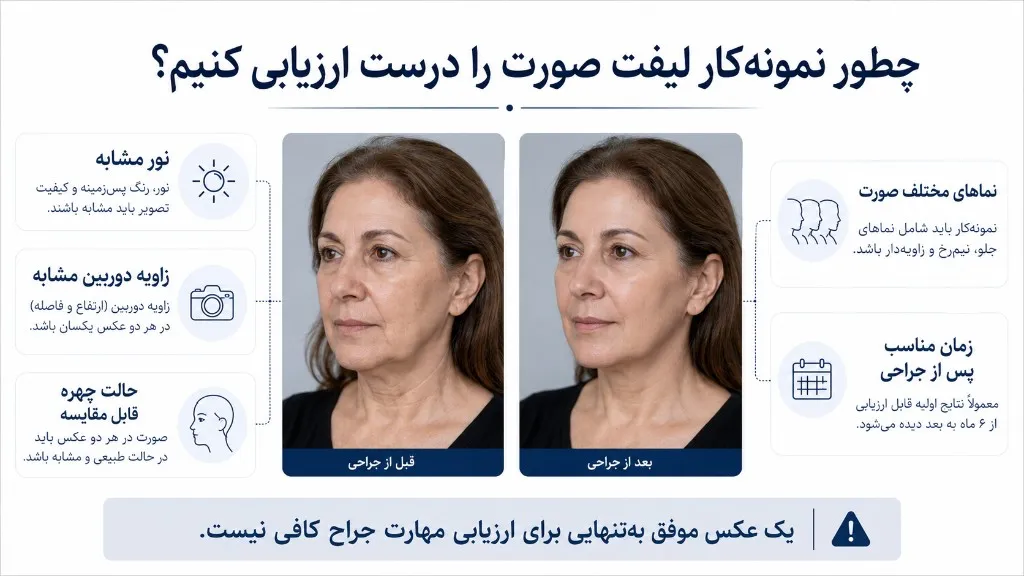
What should you look for in facelift portfolios?
1. Photography conditions
— lighting, camera angle, distance, and head position should be comparable.
2. Multiple views
— front alone is not enough; profile and three-quarter views help assess jawline and neck change.
3. Facial expression
— expression should be comparable before and after.
4. Time since surgery
— early postop photos are not final results.
5. Patient variety
— a few standout images do not represent overall performance.
Do not expect one patient’s result to be exactly repeated for another; anatomy, skin quality, laxity, age, tissues, and goals differ.
4. Take the consultation seriously
A good consultation is more than a price quote. The surgeon should assess your face, ask about your goals, and explain realistic outcomes and limits.

Questions worth preparing:
- Which technique do you recommend for my face, and why?
- Am I a suitable candidate?
- What is a realistic goal for me?
- What can and cannot be changed surgically?
- What are the most important possible complications for me?
- If a complication occurs, how is follow-up handled?
- In which center will surgery be performed?
- What anesthesia or sedation is planned?
- What recovery period should I expect?
- When can I return to daily or work activities?
- What postop visits are needed?
- When is the final result usually better to evaluate?
- Exactly what does the quoted fee include?
How the surgeon answers matters more than how many questions you ask. Clear discussion of limits and risks is more useful than absolute outcome promises.
Should a surgeon know multiple facelift techniques?
Familiarity with different approaches can matter, but the goal is not finding a doctor who only markets one named technique.
Facelift is not a single method. Choice depends on anatomy, laxity, skin quality, goals, and surgical judgment. See also mini vs full facelift.
Is Deep Plane best for everyone?
No. Deep Plane is not automatically best for every patient.
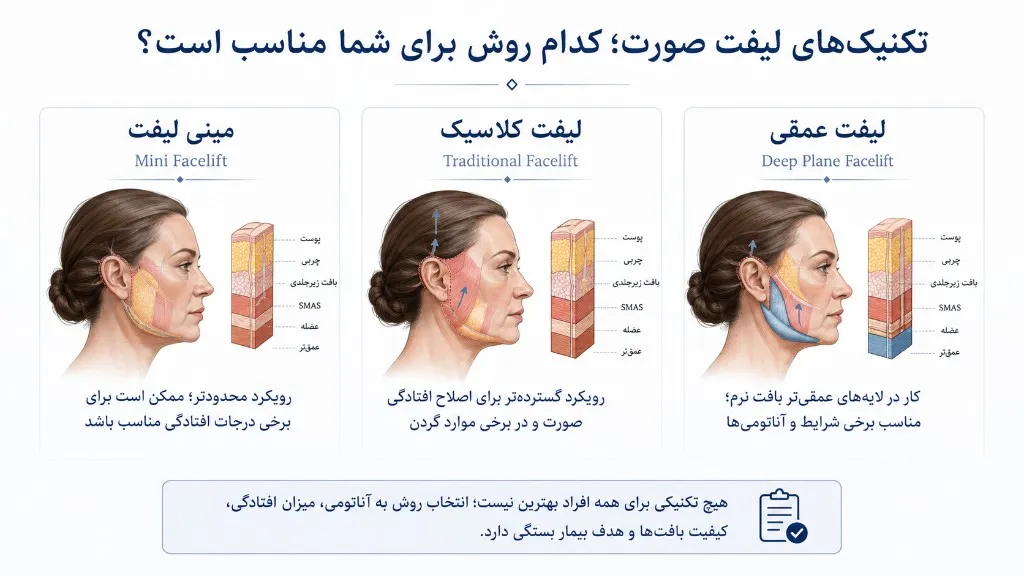
Mini Facelift, Traditional Facelift, and Deep Plane Facelift are different approaches and should be chosen individually.
| Technique | General description |
|---|---|
| Mini Facelift | A more limited approach that may suit some mild-to-moderate laxity cases. |
| Traditional Facelift | A broader approach for facial laxity and, in many cases, the neck. |
| Deep Plane Facelift | Work in deeper soft-tissue layers; appropriate in selected conditions and anatomies. |
Ask: “Which method is more suitable for my face, and why?” rather than “Which technique is best?”
5. Review safety, aftercare, and cost transparency
Choosing a surgeon is not limited to what happens in the operating room.

Know where surgery will be performed and how anesthesia and related care are managed. Clarify postop visit timing, how to contact the team if problems arise, and written aftercare guidance.
See also facelift recovery timeline and facelift pain.
How should you compare facelift cost?
The cheapest quote is not necessarily the right choice. Price may depend on procedure extent, facility, anesthesia, OR services, and aftercare. See facelift cost.
Confirm what the quoted fee includes: consultation, surgery, facility, anesthesia if applicable, postop visits, and related care. Low or high price alone is not a quality measure.
Warning signs when choosing a surgeon
These items alone do not prove a problem, but they warrant closer review:

- Promise of a guaranteed result
- Downplaying complications
- Pressure for an immediate decision
- Unclear portfolios
- Rushed consultation
- Non-transparent fees
- No clear follow-up plan
- “Best surgeon” claims without verifiable criteria
If you are choosing a facelift surgeon in Tehran
Because facelift care needs follow-up, practical access matters: office location for return visits, surgery location, postop team access, visit schedule, complication pathway, and clarity on facility and anesthesia services.
Treat search rankings for “best facelift surgeon in Tehran” as a starting point, not a final medical answer. Also see face lift in Tehran, neck lift, and temple lift when relevant.
Checklist for choosing a facelift surgeon
- I verified specialty and credentials from a reliable source
- I have enough information about real facial surgery experience
- I reviewed multiple comparable before-and-after cases
- I checked photography conditions
- I asked about the recommended technique and why
- I received explanation of risks and outcome limits
- Surgery location and anesthesia plan are clear
- I know the follow-up plan
- Cost and what it includes are transparent
- I am not under pressure to decide immediately
After choosing a surgeon: what about results?
Even a suitable surgeon does not guarantee a specific result. Outcomes depend on facial structure, tissue quality, laxity, technique, general health, and healing. A realistic goal is often reduced laxity and a more youthful, proportionate look without erasing natural features.
Summary
Use these five criteria together instead of relying on the word “best”: related specialty and credentials; real facial/facelift experience; comparable real portfolios; careful consultation and individualized planning; surgical safety, follow-up, and cost transparency.
At Facelift 360, Dr. Parsa Cheraghipour, ENT and head & neck surgeon, is listed as medical reviewer of this article. Professional details should be verified from the official doctor page and current professional sources.
If you want an individual assessment, you can book a consultation. See also the face lift service FAQ.
Medical note: This article is educational and not a substitute for examination, diagnosis, a personal treatment plan, or informed consent. Facelift candidacy, technique, anesthesia, risks, and cost must be determined after individual medical evaluation.
Frequently Asked Questions
What qualities should the best facelift surgeon have?
The right facelift surgeon should hold relevant board certification, have a long track record in facial cosmetic surgery, reviewable before-and-after cases, and a credible academic background.
Can a rhinoplasty surgeon also perform a facelift?
Yes, ENT surgeons with a focus on facial aesthetic surgery can perform facelift surgery with high skill due to their mastery of facial anatomy.
What is the best age for a facelift?
Most specialists consider ages 40 to 65 as the common range. The final decision should be made in consultation with the surgeon.
How long is the facelift recovery period?
The initial recovery period typically lasts 2 to 3 weeks. Most patients can return to daily activities after 3 to 4 weeks.
How can we tell if before-and-after results are genuine?
Pay attention to consistency of lighting and camera angle. Genuine images are taken from multiple angles and show stages of recovery.
How much does a facelift cost in Tehran?
The cost varies depending on technique, surgeon experience, and clinic facilities. Always request an itemized breakdown before the procedure.