

HIFU or Facelift Surgery: Which One Is Right for You?
This is an educational, decision-focused guide. Its purpose is to help you understand which path matches your anatomy and degree of laxity. Treatment details and booking pathways live on our service pages: Surgical Facelift and Non-Surgical Rejuvenation. To be assessed in person, use the appointment page.
One of the most common questions we hear is: "Can I just do HIFU instead of surgery?" The honest answer is sometimes yes, and more often no — and that "sometimes" depends entirely on your tissue, not on marketing. HIFU and surgical facelift are two different tools solving two different problems.
Quick summary
- HIFU is a non-invasive tightening treatment; it does not remove excess skin and does not correct moderate-to-severe descent.
- A surgical facelift addresses the deep SMAS layer, repositions loosened tissue and removes excess skin.
- HIFU makes sense for mild laxity and younger patients; facelift surgery for a blurred jawline, jowls and neck laxity.
- HIFU may modestly delay surgery in a narrow group of patients, but it is not a replacement.
What each one actually is
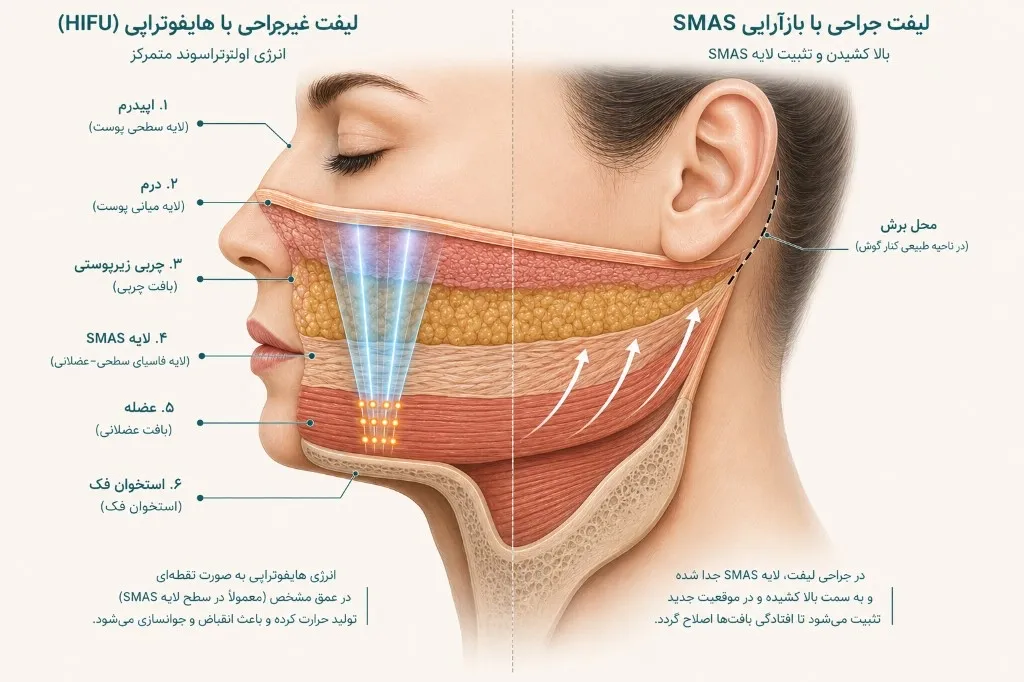
HIFU (High-Intensity Focused Ultrasound): a non-invasive treatment that focuses ultrasound energy at defined depths (typically 1.5–4.5 mm), creating micro-coagulation points. The healing response stimulates collagen remodelling, producing gradual tightening over several months. No incisions, no sutures, no skin removal.
Surgical facelift: through incisions hidden in the hairline and around the ear, the surgeon accesses the SMAS layer, lifts and fixes this loosened musculo-fascial sheet in the correct vector, then removes redundant skin. This is structural correction, not surface tightening.
How each works on the tissue
*Labels on this diagram are in Persian; see the section text for the English explanation.*
The face behaves like a layered structure: skin, subcutaneous fat, the SMAS layer, then muscle and bone. With time, collagen declines, fat compartments shift, and — most importantly — the SMAS descends. That descent is what blurs the jawline, creates jowls and deepens the folds beside the mouth.
HIFU
delivers energy into more superficial planes and, with some devices, to the border of the SMAS. Its effect is based on thermal contraction and collagen stimulation. Tissue becomes somewhat firmer, but nothing is removed and the descended layer is not repositioned. Results are therefore subtle and gradual, usually visible over two to three months.
Surgical facelift
takes the descended layer itself, lifts it in the correct direction and secures it, then removes excess skin — something no device can do. The result is not comparable to any non-surgical method.
In one honest sentence: HIFU improves tissue quality; surgery corrects tissue position.
Side-by-side comparison
| Criterion | HIFU | Surgical Facelift |
|---|---|---|
| Invasiveness / incisions | Non-invasive; no incisions or sutures | Surgical; hidden incisions in hairline and around the ear |
| Anaesthesia | Usually none or topical numbing cream | General anaesthesia, or local anaesthesia with sedation |
| Pain | Transient heat and stinging during treatment; generally tolerable | Painless during surgery; several days of tightness and discomfort, medication-controlled |
| Downtime | Essentially none; return to work same day | Typically a few weeks before social readiness; see the recovery timeline |
| Longevity | Roughly 6–18 months; requires repetition | Years; structural effect alongside natural ageing |
| Suitable degree of laxity | Mild; early softening without excess skin | Moderate to severe; blurred jawline, jowls, neck laxity |
| Relative cost | Lower per session, but recurring | Higher one-time cost; factors explained in the cost guide |
Who should choose HIFU
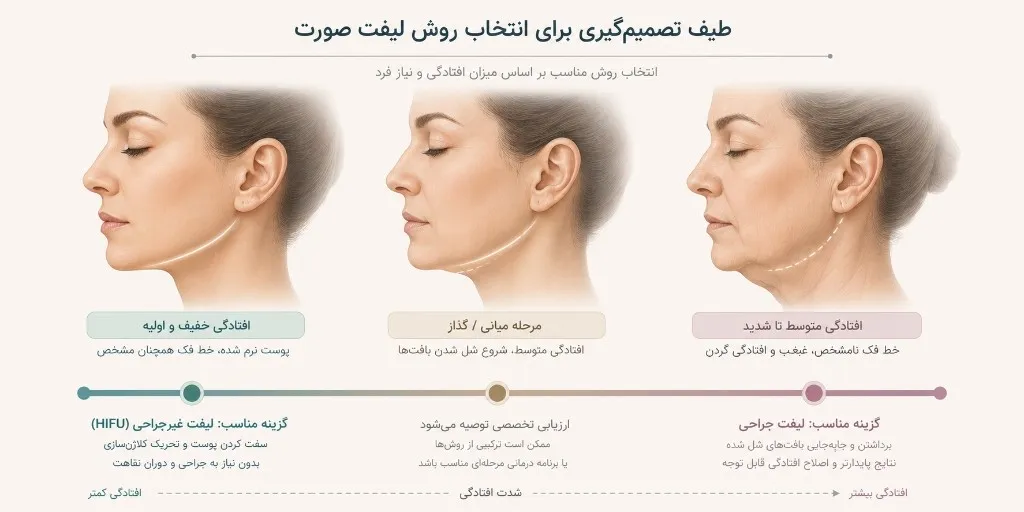
*Persian labels on the graphic; English guidance is in the sections below.*
- Approximately ages 30–45 with mild skin softening and no clear tissue descent.
- A jawline that is still definable, only slightly blurred.
- No excess skin — lifting the skin with your fingers produces little change.
- Someone who genuinely cannot take downtime and has realistic expectations.
- Patients whose medical condition makes anaesthesia unwise.
If that is you, see our non-surgical rejuvenation guide and the non-surgical facelift guide.
Who should choose surgical facelift
- A blurred jawline with no clear border between face and neck.
- Visible jowls beside the chin.
- Neck laxity or prominent platysmal bands.
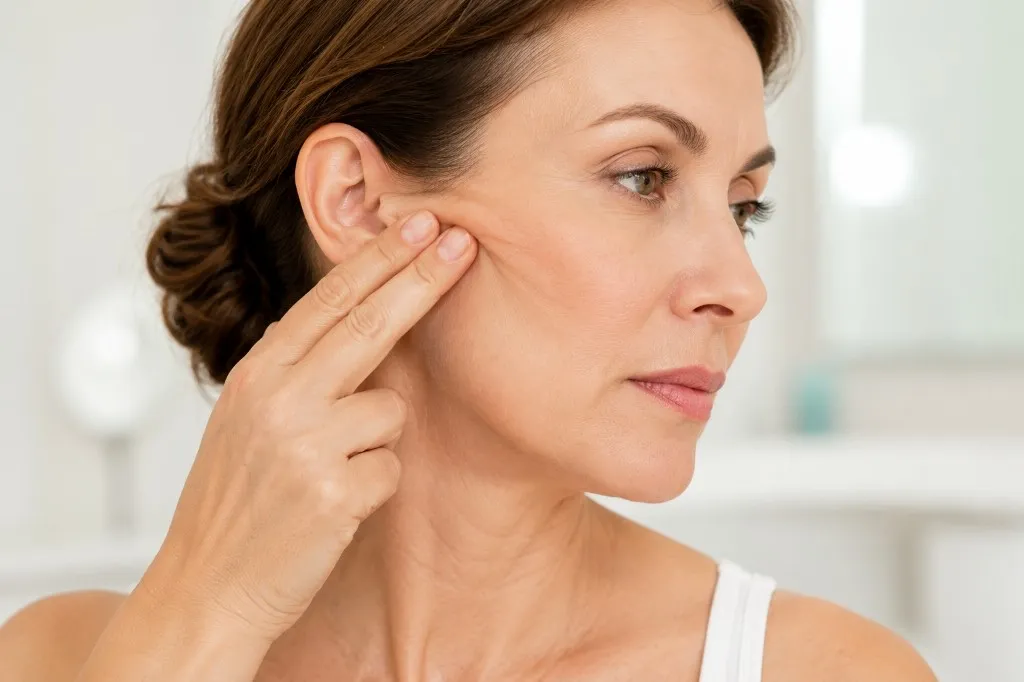
- Gently lifting the skin in front of the ear produces an obvious, pleasing change — the simplest home test for true descent.
- Excess skin is present; no energy-based device removes skin.
- Repeated non-surgical treatments have produced minimal or very short-lived results.
For candidacy, read Am I a good candidate for a facelift? and for surgical scope, mini facelift vs full facelift. A broader overview is in the facelift guide.
When HIFU is not enough
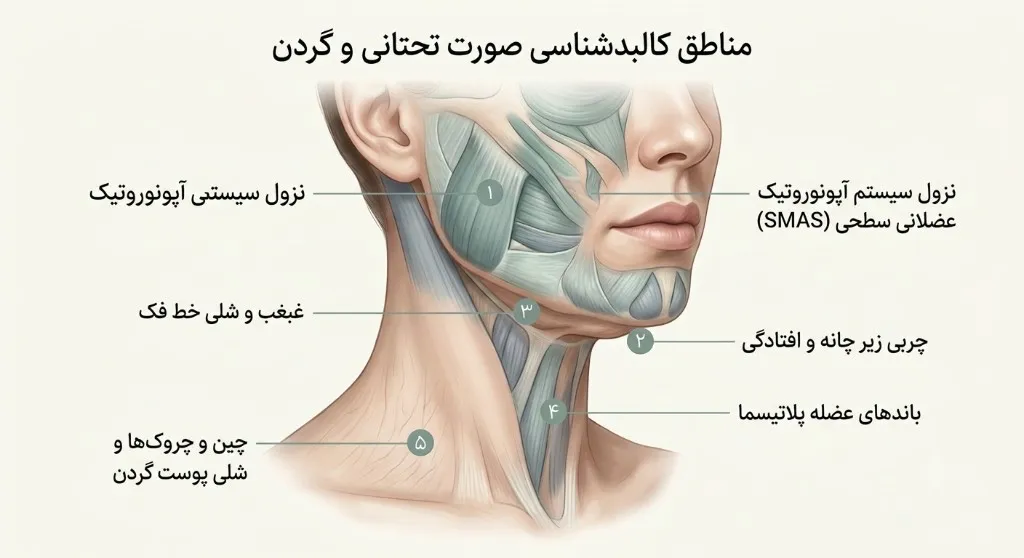
1. Moderate to severe descent. Limited thermal contraction cannot overcome the weight of descended tissue. 2. Genuine excess skin. HIFU does not remove skin. 3. Jowls and neck laxity. The neck usually requires surgical platysmal work. 4. Very thin skin with poor collagen reserve. The response may be barely perceptible. 5. Expectation of an obvious, rapid change. HIFU is subtle by nature.
Repeating a light treatment for a structural problem costs more over time and delays the real solution.
Can HIFU delay surgery?
Partly — and only in a specific group.
Yes:
someone at the very start of laxity, with no structural descent, who wants to maintain tissue quality for a few more years. Periodic sessions may preserve a sense of firmness and push the decision back somewhat.
No:
someone who already has visible descent, jowls or excess skin. Here HIFU delays the decision, not the problem.
HIFU does not stop the ageing process; it temporarily improves tissue quality.
Cost comparison
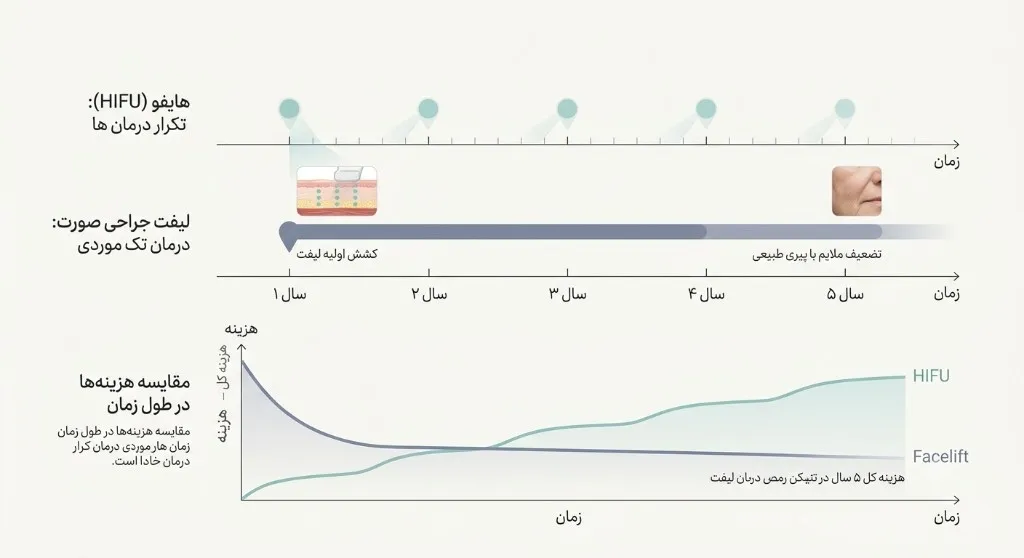
> This chart is a conceptual model, not a fixed price quote. Real fees are set after examination.
Comparing one session against one operation is misleading. The right lens is cost over time relative to the result achieved.
- HIFU: far lower per session, but recurring. Repeated every 12–18 months, the multi-year total becomes significant — while the outcome still is not comparable to surgery.
- Surgical facelift: a higher one-time cost with a structural, multi-year effect.
Cost drivers in both paths: treatment area, number of lines or surgical scope, anaesthesia type, facility standards and team experience. See the cost guide; for a personal estimate, book a consultation. We do not publish fixed guaranteed prices.
Risks and limitations
HIFU:
transient redness, sensitivity, mild swelling, occasional tingling. Serious complications are rare, though incorrect depth selection can cause transient nerve irritation or localised fat loss. Its main limitation is not medical — it is the ceiling of what it can achieve.
Surgical facelift:
as with any surgery, there is a possibility of haematoma, swelling, temporary numbness, altered sensation and, rarely, nerve injury or wound-healing problems. Correct patient selection, sound technique and disciplined aftercare reduce these meaningfully.
Other modalities such as threads, fillers, RF and endolift are covered in our non-surgical rejuvenation guide.
Decision checklist
Step 1:
In front of a mirror, gently lift the skin in front of your ear upward and back. Minimal change means surgery is probably not yet needed; obvious change means the problem is structural.
Step 2:
Look at your jawline. Still defined? Non-surgical options are reasonable. Blurred? Surgery is the logical route.
Step 3:
Check the neck. Jowls or neck laxity almost always mean you have passed the limit of non-surgical treatment.
Step 4:
Define your expectation. "Slightly fresher" → HIFU. "Get my jawline back" → surgery.
Step 5:
Assess your downtime capacity honestly and say so in consultation.
The final and most important step: an in-person examination.
Consultation with Dr Parsa Cheraghipour
Dr Parsa Cheraghipour, ENT specialist and head & neck surgeon, assesses where your tissue sits on the spectrum and whether a non-surgical option is realistic for you at all. Our approach is direct: if the lighter option is enough, we say so — and if it is not, we say that too.
FAQ
Is HIFU a replacement for a surgical facelift?
No. It stimulates and modestly tightens tissue but does not remove skin or reposition the SMAS.
How long do HIFU results last?
Usually 6–18 months depending on age, skin quality and baseline laxity.
Can I have surgery after HIFU?
Yes; previous HIFU is generally not a barrier, but mention it in consultation.
Which age suits which method?
Age alone is not the criterion; degree of descent and presence of excess skin are.
Is HIFU painful?
Transient heat and stinging that most people tolerate.
Will repeated HIFU eventually equal surgery?
No — repetition extends a temporary effect, it does not accumulate into a surgical result.
Which costs more?
HIFU is cheaper per session but recurring; surgery is a higher one-off cost with a far longer effect.
How do I know which suits me?
Only an in-person assessment of skin thickness and laxity can answer that reliably.
Scientific sources
- Review articles in *Aesthetic Surgery Journal* on the efficacy and limits of high-intensity focused ultrasound for facial and neck tightening.
- Facial plastic surgery references on SMAS anatomy and repositioning techniques, including *Plastic and Reconstructive Surgery*.
- Patient-selection guidance from the American Society of Plastic Surgeons (ASPS) and AAFPRS.
- Comparative studies on the longevity of energy-based devices versus surgical intervention.
Medical disclaimer
This article is educational and does not replace an in-person examination, diagnosis or individual medical advice. The decision between HIFU and surgical facelift should follow clinical assessment, medical history review and a discussion of your expectations. No aesthetic procedure produces identical, guaranteed results for everyone.
At a glance
- HIFU improves tissue quality; surgery corrects tissue position.
- Mild laxity without excess skin → HIFU is reasonable.
- Blurred jawline, jowls or neck laxity → surgical facelift is the right choice.
- HIFU is temporary and recurring; surgery is structural and lasting.
- HIFU can delay the decision in a narrow group, but never replaces surgery.
- The right choice follows your anatomy, not advertising.
Book your consultation to determine your path.
---
Frequently Asked Questions
Is HIFU a replacement for a surgical facelift?
No. HIFU stimulates collagen and modestly firms the tissue, but it does not remove excess skin or reposition a descended SMAS layer. They are two different levels of intervention, and in moderate to severe laxity HIFU cannot reproduce a surgical result.
How long do HIFU results last?
Typically between 6 and 18 months, depending on age, skin thickness and quality, and the baseline degree of laxity. Sessions usually need to be repeated to maintain the effect.
If I have already had HIFU, can I still have a surgical facelift later?
Yes. Prior HIFU is generally not a barrier to surgery, but you should mention it during consultation so the surgeon can account for timing and the current condition of the tissue.
What age suits HIFU and what age suits a facelift?
Age alone is not the deciding factor; the real criteria are the degree of tissue descent and whether excess skin is present. As a rough guide, HIFU is more often discussed in the thirties and early forties, and facelift surgery from the late forties onward.
If I repeat HIFU several times, will I reach a facelift result?
No. Repeating HIFU does not accumulate into a surgical outcome; it only extends a temporary effect. If the problem is structural, repeated sessions usually mean more cost and lost time.
Which one costs more?
HIFU costs less per session, but because it is recurring the multi-year total can become significant. A surgical facelift has a higher one-time cost with a far longer-lasting effect. An accurate estimate is only possible after an examination.
Is HIFU enough for jowls and neck laxity?
Usually not. The neck is one of the hardest areas for non-surgical methods, and clear laxity there often requires surgical platysmal repositioning and skin removal. HIFU produces a noticeable effect in this area only in very mild laxity.
How can I be sure which method suits me?
The only reliable way is an in-person examination assessing skin laxity, thickness and quality. Photos and online consultation can give a first impression, but they cannot replace physically assessing the tissue and the true degree of descent.