Facelift or Facial Fat Injection? Which Is Right for You
Key comparison facts
- FaceliftRepositions structure; does not add volume
- Fat graftingRestores volume; does not lift descent
- CombinationWhen descent and deflation coexist
- Substitutes?No — two problems, two solutions
This is an educational decision guide, not a service page. Procedural details live on the surgical facelift service page, and determining which approach matches your anatomy requires an in-person assessment of skin elasticity, ligament laxity and volume loss: book an assessment to choose the right path.
Quick summary
- A facelift repositions and secures descended structure; fat grafting restores lost volume. They are not substitutes for one another.
- When jawline blurring, jowling and neck laxity dominate while the face still looks full, a facelift alone is the logical choice.
- When temples, tear troughs and the midface are hollow but the jawline remains crisp, fat grafting alone is sufficient — and when both problems coexist, simultaneous combination produces a more natural three-dimensional result.
- Cost depends on indication, extent of surgery and whether fat grafting is added; a fixed price quoted before examining your face is not meaningful.
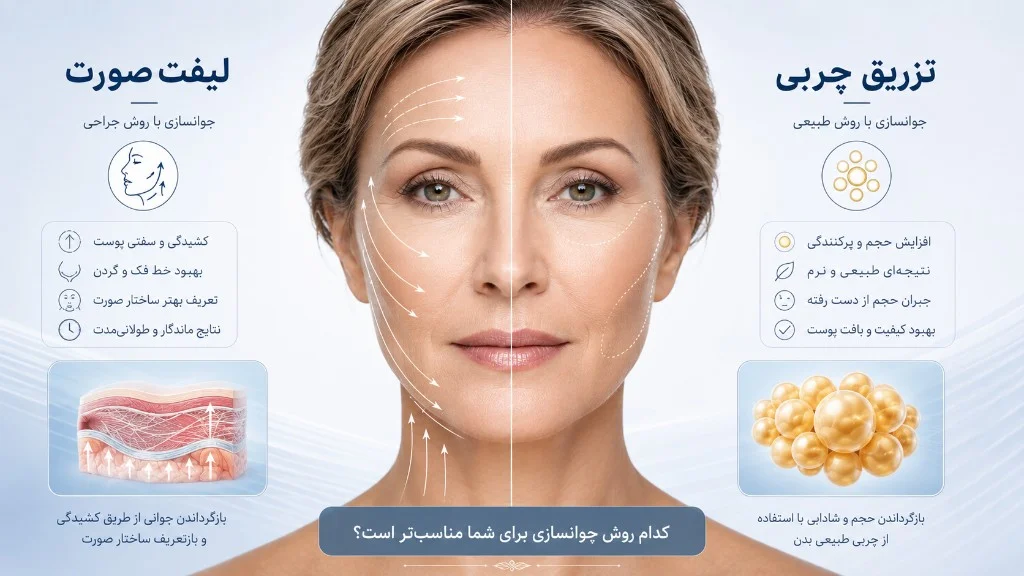
A facelift is surgery that releases the musculoaponeurotic layer beneath the skin — the SMAS — from its retaining ligaments, repositions it along the correct vector, and secures it, correcting cheek descent, marionette lines and a blurred jawline. Facial fat injection, or fat grafting, harvests the patient's own fat from a donor site such as the abdomen or flank, processes it, and transfers it to depleted areas including the temples, tear trough, cheeks and midface. The first solves a problem of tissue position; the second, a problem of tissue quantity.
Key comparison facts
- FaceliftRepositions structure; does not add volume
- Fat graftingRestores volume; does not lift descent
- CombinationWhen descent and deflation coexist
- Substitutes?No — two problems, two solutions
Facial Aging Is Not Only Skin Descent
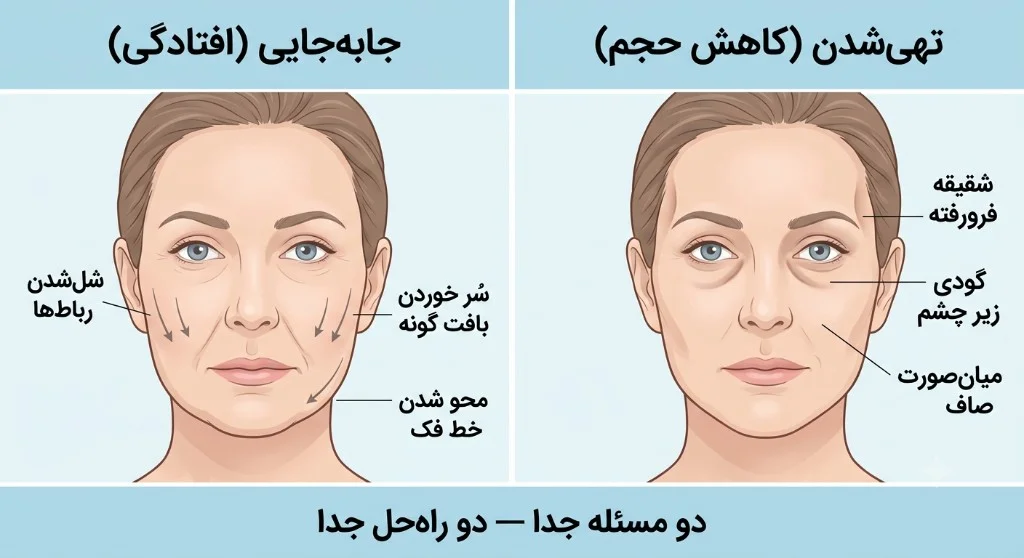
Two separate processes are usually underway at once, and telling them apart drives the entire treatment decision.
The first is descent. Retaining ligaments loosen over time and superficial fat compartments slide downward. Tissue that once sat over the cheekbone migrates toward the jawline, producing jowls, deepening folds, and erasing the crisp boundary between face and neck.
The second is deflation. Deep fat compartments — particularly the deep medial cheek and temporal fat — lose volume. At the same time, bone at the orbital rim and maxilla resorbs slightly, shrinking the platform on which soft tissue rests. The face is not merely fallen; it is emptied. Temples hollow, tear troughs cast shadows, and the midface flattens.
These problems do not share a solution. Pulling the skin of a face whose real deficit is volume produces a thinner, more operated look. Filling a face whose tissue has genuinely descended only adds weight to an already sagging area.
What a Facelift Does and Does Not Do
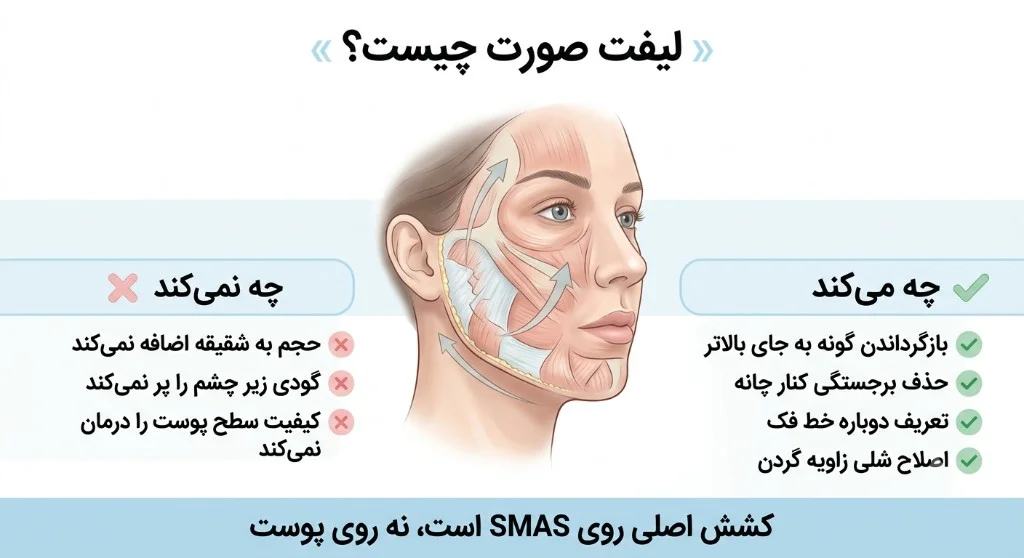
A facelift is a structural intervention. Through incisions hidden in the hairline and natural creases around the ear, the surgeon accesses the SMAS, releases it — from plication through to deep-plane dissection depending on technique — repositions it upward and obliquely, and fixes it. Skin is redraped last, without tension; the lift lives in the SMAS, not the skin.
What it does well: restoring descended cheek tissue, eliminating jowls, redefining the jawline, and correcting cervicomental laxity.
What it does not do: add volume. Hollow temples and deep tear troughs are not filled by repositioning tissue. Surface quality — pigmentation, pore size, fine perioral lines — is a separate matter requiring separate skin treatment.
For a full review of techniques and expectations, see the complete facelift guide.
What Facial Fat Grafting Does and Does Not Do
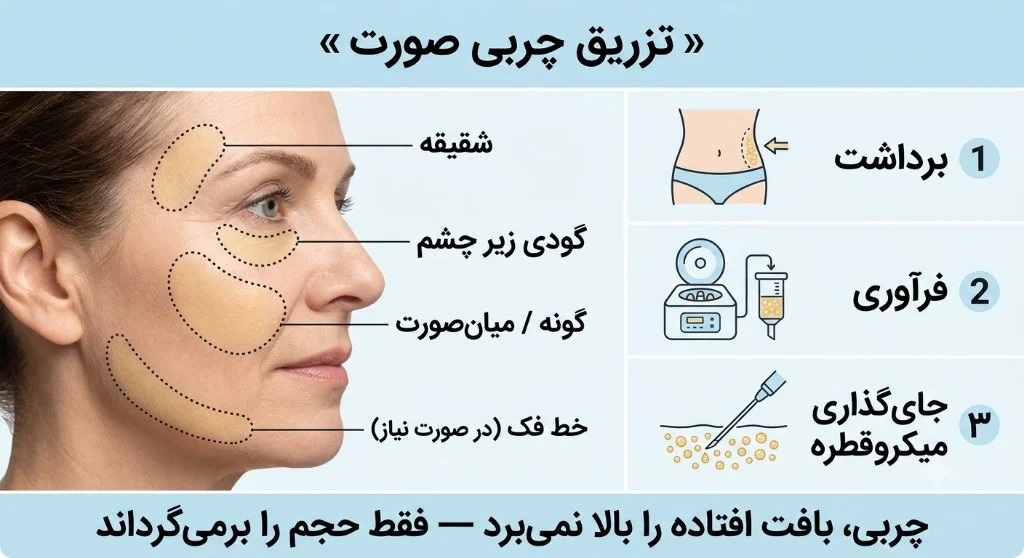
Fat grafting has three stages, and all three determine the result.
Harvest.
Fat is taken by low-pressure liposuction with a fine cannula from the abdomen, flank or inner thigh. Suction pressure and cannula diameter matter, because adipocytes are fragile.
Processing.
Harvested fat must be separated from blood, free oil released by damaged cells, and residual infiltration fluid. Decantation, centrifugation and filtration are the common methods.
Placement.
Processed fat is deposited as microdroplets through very fine cannulas along multiple tunnels and across several planes. Each droplet must contact vascularized tissue to survive and revascularize. Depositing a large bolus in one spot leads to oil cysts and fat necrosis.
Three terms describe particle size: macrofat for larger-volume restoration such as the cheek, microfat for delicate areas, and nanofat, which contains essentially no viable adipocytes and is used mainly to improve skin quality. evidence on the magnitude and durability of nanofat's effect on skin quality is still developing and should not be promised as a definite outcome.
An important point before deciding: a proportion of grafted fat is resorbed. What remains after several months is living, established tissue considered durable, but the retained percentage varies widely between patients and between regions of the same face. reported retention ranges vary across studies; a precise figure cannot be predicted for an individual patient, and realistic planning includes the possibility of a touch-up session.
What fat grafting does not do: it does not lift descended tissue, remove excess skin, or restore a blurred jawline. Adding large volume to a structurally descended face produces a heavy, swollen result — not a younger one.
Head-to-Head Comparison
| Criterion | Facelift | Facial fat grafting | Simultaneous combination |
|---|---|---|---|
| Treatment goal | Reposition and secure descended structure | Restore lost volume | Correct position and volume together |
| Primary candidate | Cheek descent, jowling, neck laxity with relatively preserved volume | Hollow temples and midface, tear-trough shadowing, still-crisp jawline | Both descent and deflation; typically more advanced aging |
| Relative durability | Long-lasting; repositioned structure holds, though aging continues | Established portion is durable, but touch-up may be needed after initial resorption | Structural durability of the lift plus established volume |
| Approximate social downtime | Longer; significant bruising and swelling in early weeks | Shorter; recipient-site swelling and donor-site bruising | Close to facelift alone, with more early swelling |
| Anesthesia | Usually general anesthesia or deep sedation | Local with sedation through to general, depending on volume | A single anesthetic for both |
| Key differentiating risks | Hematoma, temporary nerve dysfunction, scar-related issues | Surface irregularity, asymmetry, uneven resorption, oil cyst, donor-site contour | Longer operative time, greater early swelling |
| Relative cost | Higher; depends on extent and technique | Lower than facelift in most cases | Highest in a single session, but usually less than two separate surgeries |
Who Needs a Facelift Alone?
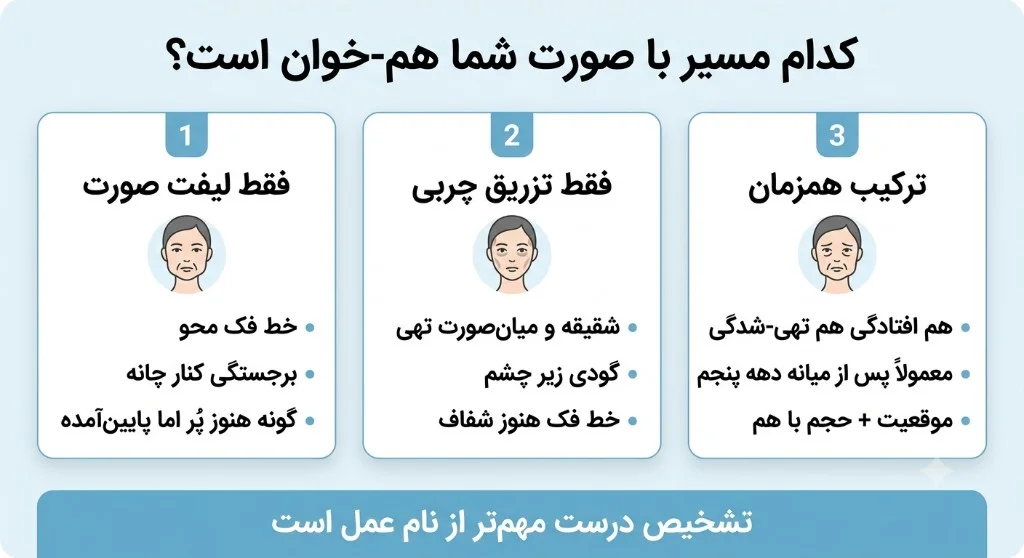
The pattern is clear. Someone whose main problem is descent complains about the jawline, not hollow cheeks. In photographs from several years ago, facial volume was similar — but the borders were sharper.
- Jowls are visible and the face-to-neck boundary has blurred.
- The cheek is still full, but that fullness sits lower than it should.
- Temples are not hollow and tear troughs are not deep.
- Lifting the skin near the ear upward and backward in the mirror restores a natural look without any sense that something needs filling.
In these faces, adding fat does not help and may worsen heaviness in the descended zone.
Who Needs Fat Grafting Alone?
This group is usually younger — often in their thirties to early forties — and describes looking tired or hollow rather than fallen.
- Temples are hollow and the upper facial frame has narrowed.
- Tear troughs cast shadows and the midface has flattened.
- The jawline is still defined and neck skin shows no meaningful laxity.
- Skin elasticity is good; it recoils quickly after pressure.
- Significant weight loss or a naturally lean structure has reduced facial volume.
Here, a facelift is not merely unnecessary — it can make the face look leaner and older.
Who Is a Candidate for Simultaneous Combination?
Most patients presenting after their mid-fifties fall cleanly into neither category. Their face has both descended and deflated.
- The jawline has blurred while temples and midface are hollow.
- Tear troughs are deep, yet jowls are also present.
- A prior facelift has left a "pulled but empty" appearance.
- Facial borders are indistinct and the underlying volume base has diminished.
The logic is straightforward: the lift returns tissue to the right place; fat replaces what was lost. Neither does the other's job.
Combining Facelift and Fat Grafting in One Session
In a combined plan, fat is typically harvested and processed at the start, the surgeon then works on the SMAS, and fat is placed last. The reason is that the true site of volume deficit only becomes apparent once structure has been repositioned. Injecting before lifting invites a misjudgment of required volume.
Single-stage or staged?
Doing both in one session means one anesthetic, one recovery and one operating-room cost — often the more sensible option. A surgeon may prefer staging when large fat volumes are required, when general health does not justify a long operation, or when the lift result should settle before volume decisions are made.
Safety.
Simultaneous combination is an established approach in experienced hands, but it lengthens operative time and increases early swelling, making preoperative assessment, medication review and smoking cessation more consequential.
If your plan includes other procedures in the same session — neck, eyelids or brow — the planning logic is covered in combining a facelift with complementary procedures.
How Is Fat Grafting Different from Gel Filler?
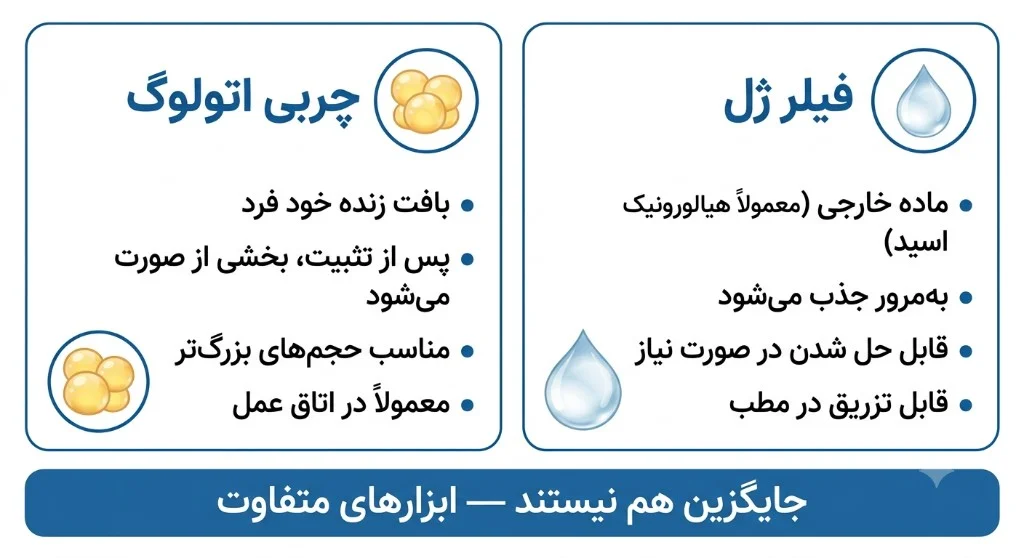
The two are not interchangeable. Autologous fat is your own living tissue, which revascularizes once established and becomes part of the face. Gel filler, usually hyaluronic acid based, is a foreign material that resorbs over time, can be injected in clinic, and can be dissolved if needed.
Fat suits larger-volume restoration in a single surgical session; filler suits localized, gradual, lower-commitment correction. Neither replaces the other.
Non-surgical options are covered in non-surgical facial rejuvenation and non-surgical facelift.
Risks, Limitations and Red Flags
Only the differentiating risks are covered here; the full list of general surgical complications appears in facelift risks and complications.
Specific to fat grafting:
uneven resorption and resulting asymmetry, palpable surface irregularity, oil cyst formation, fat necrosis where large boluses are placed, and donor-site contour irregularity.
Warning
Fat injection in high-risk facial zones — particularly the periorbital region, glabella and temple — can cause vascular occlusion if fat inadvertently enters a vessel. This complication is rare but serious. reported incidence is very low and figures differ across sources; what is not in doubt is the need for a surgeon familiar with facial vascular anatomy, using blunt cannulas and low injection pressure.
Fat injection in high-risk facial zones — particularly the periorbital region, glabella and temple — can cause vascular occlusion if fat inadvertently enters a vessel. This complication is rare but serious. reported incidence is very low and figures differ across sources; what is not in doubt is the need for a surgeon familiar with facial vascular anatomy, using blunt cannulas and low injection pressure.
Specific to facelift:
early hematoma, temporary skin numbness, and scar-healing issues.
Specific to combination:
longer operative time and greater early swelling, which makes interpreting the result harder in the first weeks. A short recovery comparison appears in facelift recovery tips.
Red flags:
a promised exact fat-retention percentage before surgery; a firm price without in-person examination; the claim that fat grafting alone replaces a facelift and corrects descent; no discussion of a possible touch-up; and a proposal of very large fat volumes in one session for a "more dramatic result."
Decision Checklist

- Is descent dominant? Is your main complaint a blurred jawline and jowls?
- Is volume loss dominant? Are temples and tear troughs hollow while facial borders remain crisp?
- Both? In older photographs, were the borders sharper and the face fuller?
- How is skin elasticity? Does skin recoil quickly after pressure?
- Does general health permit surgery? Comorbidities, anticoagulants and smoking are decisive in planning.
- What do you expect? "Like myself ten years ago" is realistic; "like someone else" is not.
- Do you have the recovery time? Combination requires more serious planning for time off.
Relative Cost in Comparison
Honestly: any site quoting a fixed number for a facelift — or for a facelift combined with fat grafting — is quoting a figure that means nothing before your face has been examined. Cost here follows indication, not procedure name.
Determining factors include the extent and technique of the lift, whether fat grafting is added and in what volume, anesthesia type and operating-room duration, the possibility of a touch-up session for fat, and the surgical facility and anesthesia team.
One point rarely made: performing both in a single session usually costs less than two separate surgeries, because facility and anesthesia costs are paid once. All figures in Iran are quoted in Toman (IRT). For a detailed treatment of pricing factors, see the facelift cost guide.
Why Correct Diagnosis Matters More Than the Procedure Name
The choice between lift, fat and combination is a diagnosis before it is a technique. A surgeon who cannot distinguish descent from deflation at examination may execute the wrong plan flawlessly. In fat grafting, knowledge of facial vascular anatomy and skill in microdroplet placement separate a natural result from a lasting irregularity.
Dr. Parsa Cheraghipour
Surgeon and ENT specialist
Approximately 15 years of specialized experience in facial cosmetic surgery
Member of the Iranian Society of Plastic and Aesthetic Surgeons
Board certified in maxillofacial surgery
Facelift 360 Center — Tehran, Mirdamad Boulevard
View full profile
Surgeon and ENT specialist
Approximately 15 years of specialized experience in facial cosmetic surgery
Member of the Iranian Society of Plastic and Aesthetic Surgeons
Board certified in maxillofacial surgery
Facelift 360 Center — Tehran, Mirdamad Boulevard
View full profile
Criteria for evaluating a surgeon are set out in choosing the best facelift surgeon, and the procedure itself is described on the surgical facelift page.
Scientific Sources
This article is based on accepted principles in facial aesthetic surgery. Clinical studies and reviews published in plastic surgery literature indicate that facial aging results from a combination of soft-tissue descent and volume loss in fat compartments and the underlying bony platform — the finding that underpins the combined approach to facial rejuvenation. Reported fat-graft retention ranges are not consistent across sources and depend on harvest method, processing technique, recipient site and individual factors, which is why no definitive figure is stated here.
At a Glance
- A facelift solves tissue position; fat grafting solves tissue quantity. They are not competitors.
- Jawline descent and jowling with preserved volume indicates a facelift alone.
- Hollow temples and midface with a crisp jawline and elastic skin indicates fat grafting alone.
- Coexisting descent and deflation is the common picture after the mid-fifties and makes simultaneous combination logical.
- Autologous fat is not gel filler: one is your own living tissue, the other a resorbable, dissolvable material.
- A proportion of grafted fat resorbs, and a touch-up should be anticipated from the outset.
- Combining in one session usually costs less than two separate surgeries but produces more early swelling.
- A promised retention percentage or a firm price without examination is a warning sign.
Medical Disclaimer
This article is educational only and does not replace in-person examination, diagnosis or medical advice. Deciding between a facelift, fat grafting or their combination requires individual assessment of anatomy, medical history and expectations. No outcome in aesthetic surgery is guaranteed.
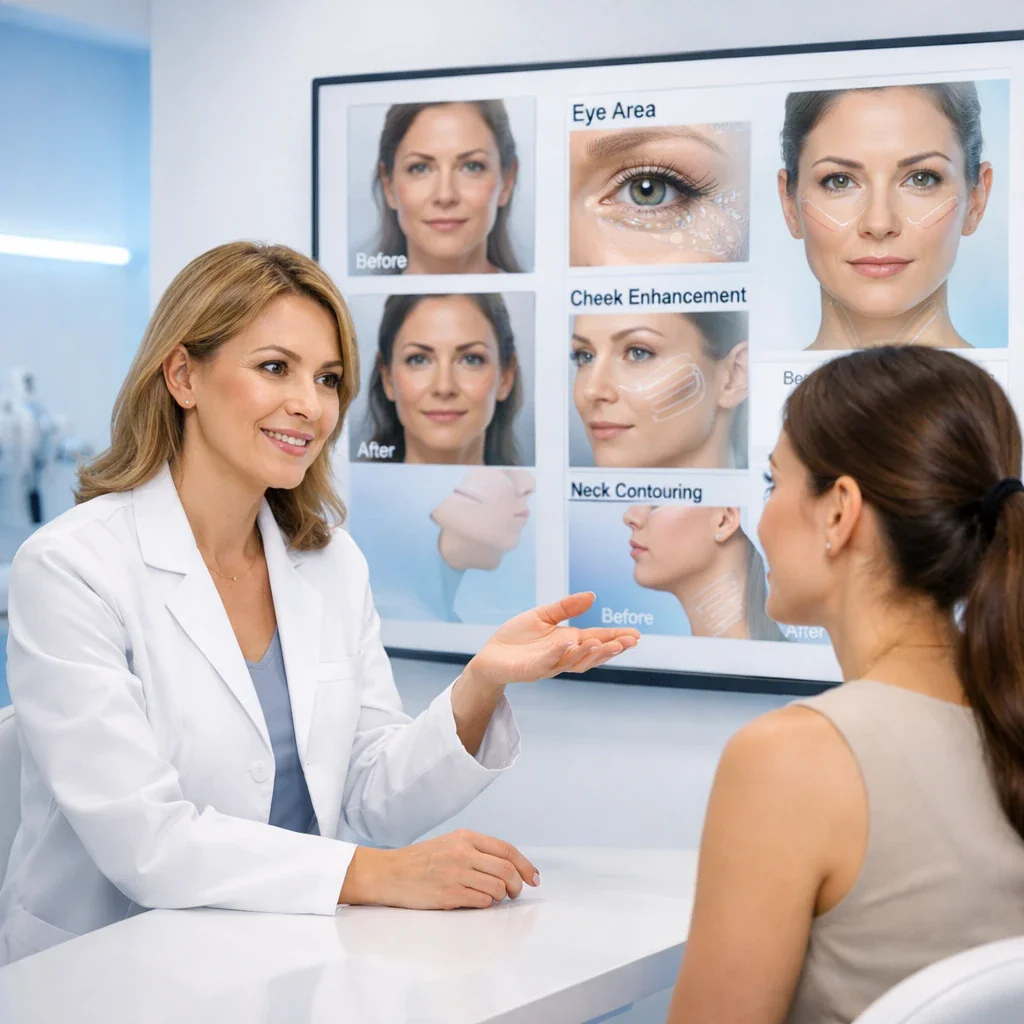
The best way to know whether a facelift, fat grafting, or simultaneous combination suits your situation is a specialist consultation.


Frequently Asked Questions
Facelift or fat injection — which should come first?
This arises when both problems coexist. In most combined plans the correct order is to reposition structure first and add volume second, because the true site of volume deficit only becomes apparent once tissue is back in position. If the two are staged separately, the facelift usually comes first.
Does fat grafting replace a facelift?
No. Fat adds volume but does not lift descended tissue or remove excess skin. If the main problem is a blurred jawline and jowling, adding volume only increases heaviness in that area. Any claim that fat grafting alone does the work of a facelift is a red flag.
When is fat grafting alone sufficient?
When the dominant problem is deflation rather than descent: hollow temples, tear-trough shadowing and a flattened midface, while the jawline remains crisp and skin elasticity is good. This pattern is most common in the thirties to early forties and after significant weight loss.
Is combining a facelift and fat grafting in one session safe?
In experienced hands, performing both in a single session is an established approach, with the advantage of one anesthetic and one recovery. Operative time is longer and early swelling greater, so general health assessment, medication review and smoking cessation carry more weight beforehand.
How long does injected facial fat last?
A proportion of grafted fat resorbs in the first months; what remains is living, revascularized tissue considered durable. Retained percentage varies widely between patients and even between regions of one face, depending on harvest method, processing and recipient bed a definite figure cannot be stated for an individual patient.
How does autologous fat differ from gel filler?
Autologous fat is your own living tissue, which revascularizes once established and becomes part of the face. Gel filler, usually hyaluronic acid based, is a foreign material that resorbs over time, is injectable in clinic and can be dissolved if needed. Fat suits larger volumes; filler suits localized, lower-commitment correction.
How much longer is recovery after a combined procedure?
Recovery from a combined procedure is close to that of a facelift alone, except that early swelling is greater and more persistent, making the result harder to interpret in the first weeks. Fat grafting alone usually has the shortest downtime, though donor-site bruising should be factored in.
If some fat resorbs, will a touch-up be needed?
Sometimes. Partial resorption is a normal feature of the technique, and in some patients — particularly where large volumes were required or the recipient bed had limited vascularity — a touch-up session is performed to achieve symmetry and the desired volume. This possibility is best anticipated in both the timeline and the budget.
Are men candidates for a combined facelift and fat grafting?
Yes. The diagnostic principle is identical: separating descent from deflation. The differences lie in planning — incision design accounting for beard growth and hairline, and more conservative volume choices that preserve masculine facial angles rather than rounding them.
What is the appropriate age range for each?
Age alone is not decisive; the anatomical pattern is what matters. Broadly, fat grafting alone tends to arise in the thirties to early forties, a facelift usually from the late forties onward, and simultaneous combination most often after the mid-fifties. These are general guides, not rules.
What preparation is needed before a combined procedure?
Beyond routine preoperative testing, smoking cessation matters particularly, because perfusion affects both flap healing and graft survival. Medications and supplements affecting coagulation must be adjusted with the surgeon, and since fat is harvested from the body, a stable weight beforehand helps the durability of the result.
Where is the fat harvested from, and does that area change shape?
Common donor sites are the abdomen, flank and inner thigh, chosen on the basis of fat quality and patient preference. The volume needed for the face is small compared with conventional liposuction, so expecting visible slimming at the donor site is unrealistic. Uneven harvesting can create minor contour irregularity, preventable with even removal.
Is a simultaneous combination more expensive than doing them separately?
In a single session the total is higher than either procedure alone, but compared with two separate surgeries it usually costs less, because facility, anesthesia and postoperative care are paid for once. Pricing factors are set out in the facelift cost guide, and all figures are quoted in Toman (IRT).
Does insurance cover a facelift or fat grafting?
Honestly: when the purpose is cosmetic, these procedures are typically not covered. Exceptions are limited to reconstruction after trauma, surgery or disease, and each requires case-specific approval and documentation. Check your own policy terms directly before financial planning.