
Deep Plane vs SMAS Facelift: Which Technique Is Right for You?
This is an educational guide. For individual consultation and booking, see the face lift service page.
Short answer
Deep Plane and SMAS are two families of facelift techniques that differ in dissection depth and how retaining ligaments are handled. In SMAS approaches, this fibromuscular layer is typically plicated or lifted from its own surface; in Deep Plane, skin and SMAS move together as a composite flap beneath that layer, and some retaining ligaments are released. Current evidence does not confirm one approach as universally superior — selection depends on facial anatomy, sagging pattern, patient goals, and surgeon experience.
The terms SMAS and Deep Plane appear frequently in facelift consultations, partly because clinics market one as the "most advanced" option. Both are real surgical concepts, but the explanation patients usually hear is simpler than surgical reality.
"SMAS" is an umbrella term, not a single operation. Under it fall multiple techniques — from simple plication to SMASectomy and SMAS flaps — with different dissection levels and outcomes. Deep Plane is a specific approach below the SMAS layer, with many variants developed over three decades. The meaningful comparison is not "SMAS vs Deep Plane" in the abstract, but which specific version of each your surgeon performs.
What is a SMAS facelift?
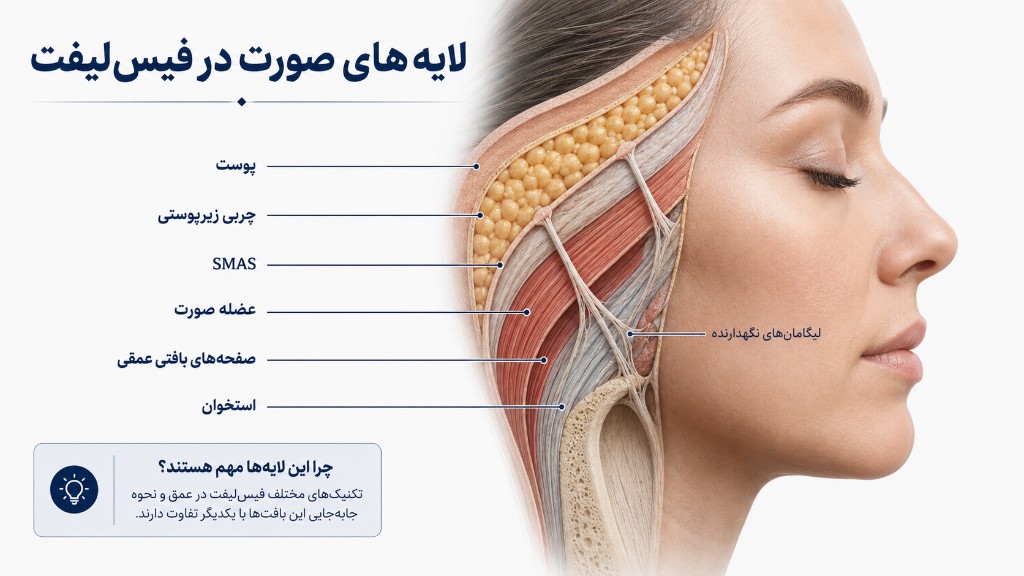
SMAS stands for Superficial Musculoaponeurotic System — a fibromuscular layer beneath subcutaneous fat and above facial muscles that connects face and neck in a continuous network. Like other facial tissues, it loosens and sags with age.
Under "SMAS facelift" fall several techniques: plication (folding and suturing the layer without excision), SMASectomy (removing a strip and approximating edges), and SMAS flap (elevating the layer as an independent flap). They differ in dissection extent and lift power, but typically work from the SMAS surface while deeper retaining ligaments usually remain intact.
Involving the SMAS transfers lift tension to a stronger fibrous layer rather than skin alone, allowing skin to close with less tension and more durable results than skin-only lifting.
What is a Deep Plane facelift?
Hamra first described the Deep Plane facelift in 1990; since then, many variants including extended deep plane have been published. "Deep plane" refers to a level beneath the SMAS.
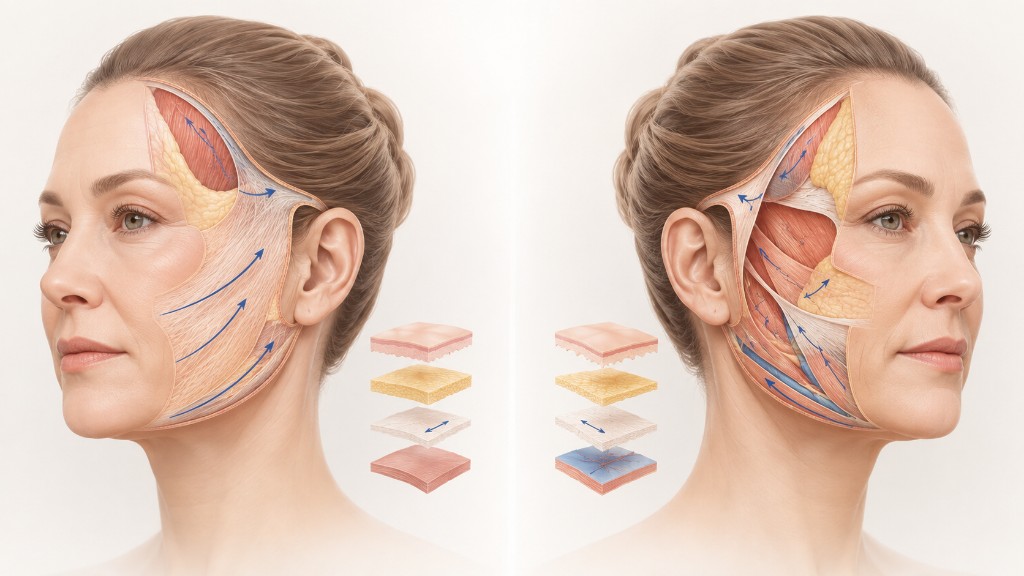
The key difference is not merely "going deeper" but how skin, SMAS, and deeper tissues relate. Skin and SMAS move together as a composite flap rather than being dissected separately, preserving blood supply and enabling coordinated tissue repositioning.
Another component is releasing some retaining ligaments. In many Deep Plane techniques, the zygomatic ligament (McGregor's patch, described by Furnas in 1989) and masseteric ligament are released. These anchor cheek tissue to the zygoma; until released, even strong superficial pull cannot effectively reposition the midface.
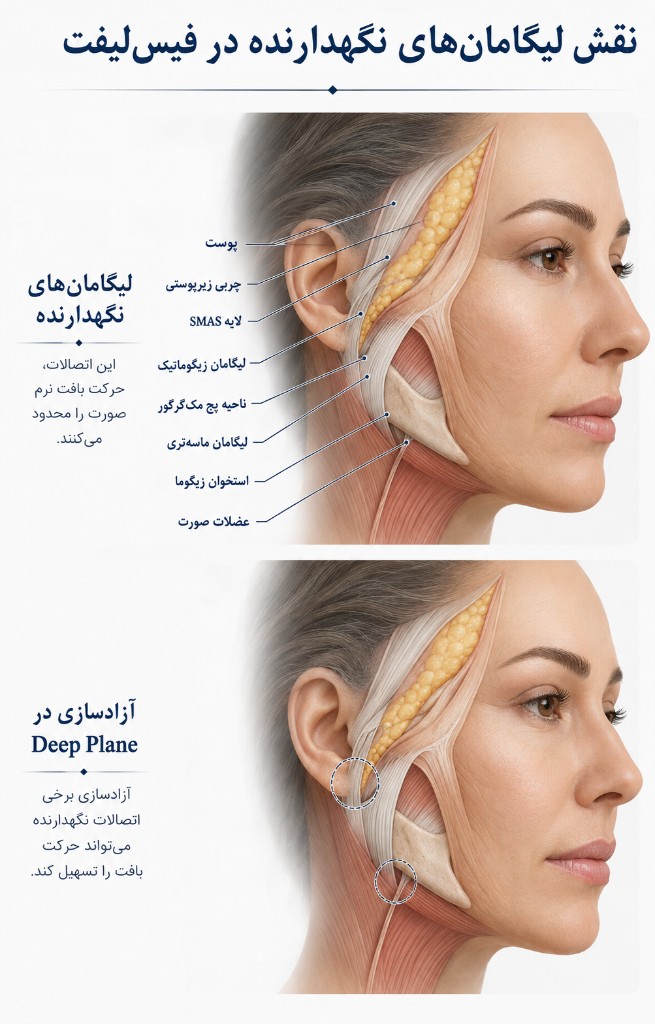
Which ligaments are released and to what extent varies by surgical variant — the pattern described is common, not a universal protocol.
How do Deep Plane and SMAS differ?
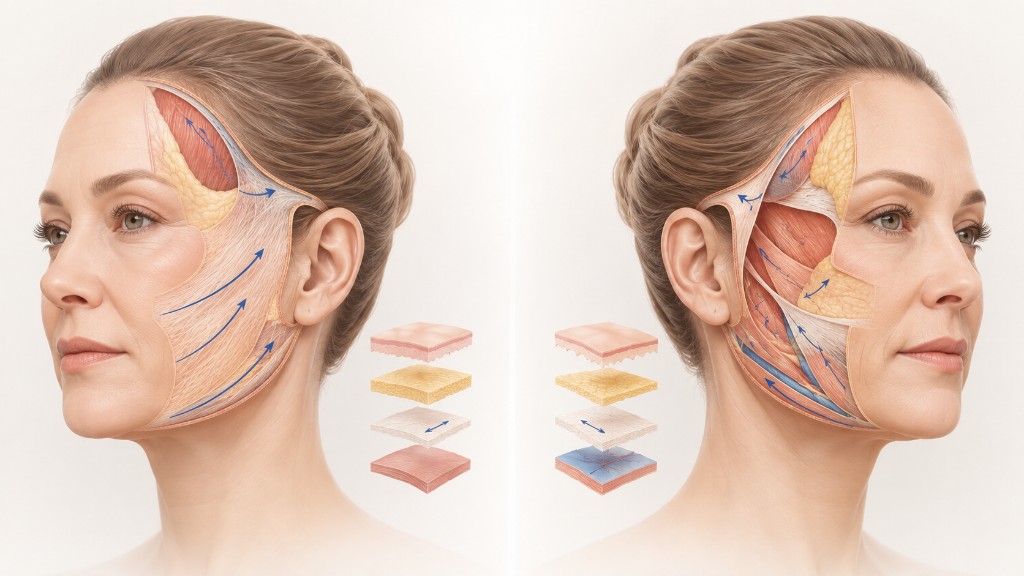
Retaining ligaments
are the main axis of distinction. Standard SMAS approaches typically do not directly address major retaining ligaments; many Deep Plane variants release zygomatic and masseteric ligaments, enabling better midface access. Standard SMAS more often affects the lower face and jawline, though extended SMAS and High-SMAS have narrowed this gap.
Tissue movement:
In most SMAS approaches, skin and SMAS are dissected separately with a lateral vector; in Deep Plane, skin, SMAS, and some deeper fat move as one unit with a more vertical vector.
Dissection extent:
Deep Plane is generally more extensive and closer to sensitive facial nerves. This makes it typically more complex and requiring greater specialist experience.
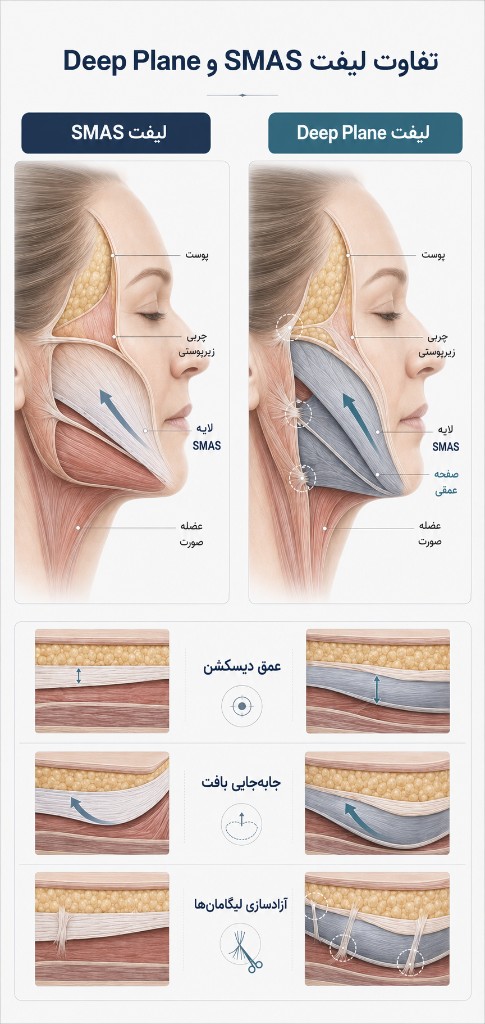
Comparison table
| Feature | SMAS approaches | Deep Plane |
|---|---|---|
| Target layer | SMAS surface | Below SMAS; skin + SMAS as composite unit |
| Tissue movement | Usually separate skin/SMAS; lateral vector | Unified flap; more vertical vector |
| Ligament release | Usually limited | Often direct zygomatic and masseteric release |
| Common use | Jawline and lower face sagging | Broader sagging including midface and nasolabial folds |
| Complexity | Range from simple to advanced | Usually requires more specialist experience |
Is Deep Plane better than SMAS?
No — neither can be declared universally superior. A 2025 systematic review and meta-analysis (Vayalapra et al., 47 studies, 10,766 patients) found comparable hematoma and infection rates; nerve injury (mostly temporary) showed no significant difference. Authors concluded evidence is heterogeneous and insufficient to prove definitive superiority of either approach.
Who is each approach for?
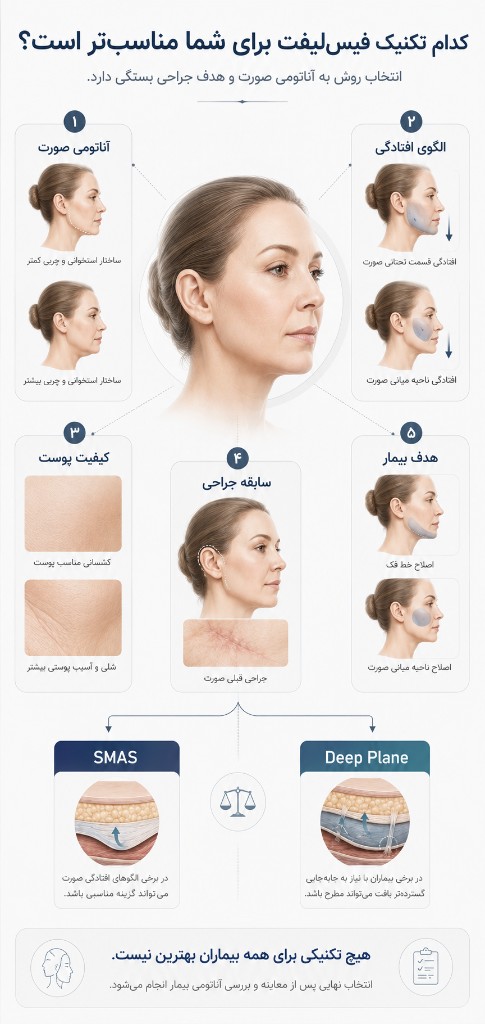
Clinical patterns (not fixed rules): lower-face/jawline sagging may suit standard SMAS; midface sagging or deep nasolabial folds may favor approaches releasing the zygomatic ligament. Final decision requires in-person examination. See also the complete face lift guide and mini vs full facelift.
Complications and safety
Both are surgeries with risks including hematoma, infection, swelling, temporary numbness, nerve injury, asymmetry, and scarring. Vayalapra 2025 reported hematoma rates around 3% for deep techniques and 2% for SMAS approaches in studied populations — these are study averages, not individual risk predictions.
Questions to ask your surgeon
- Which specific SMAS or Deep Plane variant do you recommend for my anatomy, and why?
- Which tissue layers move and which ligaments, if any, are released?
- Is technique choice based on my examination or your default approach?
- What limitations and recovery should I expect?
See how to choose a facelift surgeon and how long facelift results last.
--- *Educational content only — not a substitute for examination or individualized treatment planning.*
Frequently Asked Questions
What is the difference between Deep Plane and SMAS?
The main difference is dissection depth and handling of retaining ligaments. SMAS approaches work from the surface of this fibromuscular layer; Deep Plane moves beneath it, repositioning skin and SMAS as a composite flap and often releasing zygomatic and masseteric ligaments.
Is Deep Plane better than SMAS?
Current evidence does not confirm one approach as universally superior. The 2025 meta-analysis showed comparable complication rates. Selection depends on anatomy, sagging pattern, goals, and surgeon experience in a specific technique.
Who is each approach best for?
Deep Plane is often considered when midface sagging or prominent nasolabial folds are present. SMAS approaches often suit patients with mainly jawline and lower-face sagging. These are general patterns — final decision requires in-person examination.
Does Deep Plane give more natural results?
Natural results depend on tissue vectors, extent of correction, skin management, and overall surgical design — not a single technique name. Direct comparative aesthetic evidence remains limited.
Does Deep Plane last longer?
Direct long-term comparative data remain limited and heterogeneous. Durability depends on skin quality, lifestyle, genetics, and ongoing aging — not technique name alone.
Is SMAS an outdated technique?
No. SMAS is an umbrella term for several techniques still widely used with reliable results. Calling it "old" oversimplifies — these approaches continue to evolve.
How is facelift technique chosen?
Selection is usually made at in-person examination based on facial anatomy, sagging pattern, skin quality, medical history, and patient goals — plus the surgeon's experience in a specific technique.