Smoking and Vaping Before and After a Facelift: What to Know
This is educational content. The surgeon sets the cessation plan for each person. This page does not replace examination, consent, or the treating team’s instructions. The procedure path is on the face lift service page.
Smoking and vaping are not just lifestyle details when someone is preparing for a facelift. Cigarette smoke lowers tissue oxygen, and nicotine narrows blood vessels. After a facelift, facial skin depends more than usual on the fine vessels under the skin. The cessation plan should be settled with the surgeon before the operation date is fixed.
Short answer: smoking is associated with slower wound healing and a higher chance of some surgical complications. That does not mean every smoker has a complication, or that smoking is the only cause when one occurs. Vaping and other nicotine products are not a proven safe substitute; direct evidence about them is thinner than the evidence on cigarettes. The surgeon sets the interval for that person, based on health and the extent of surgery.
How does smoking affect wound healing after a facelift?
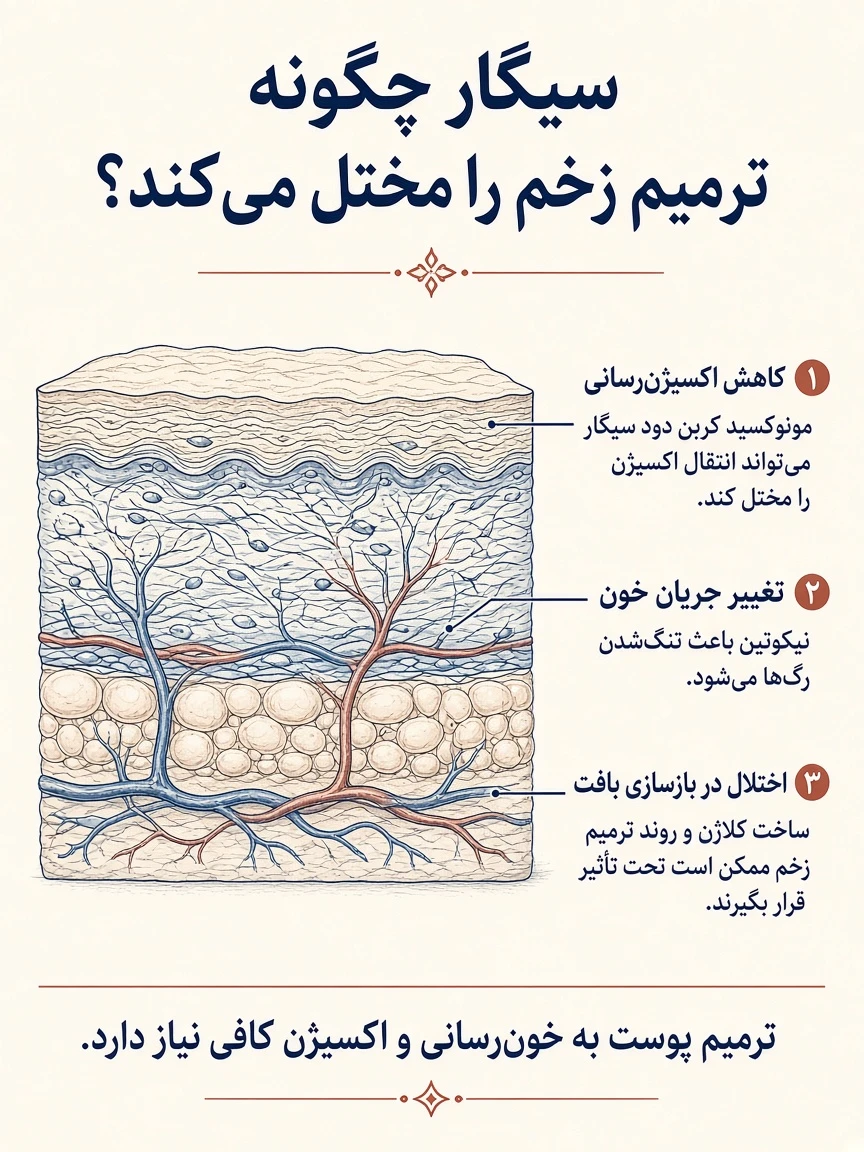
Smoking interferes with healing along at least three paths.
It reduces tissue oxygen. Cigarette smoke contains carbon monoxide. The American Society of Plastic Surgeons’ 2024 practice reference links adverse effects of smoking to nicotine and to carbon monoxide. A mechanistic review found that smoking temporarily lowers tissue oxygenation and aerobic metabolism.
It affects local blood flow. The same reference treats nicotine-related vasoconstriction as important in operations that depend on adequate tissue perfusion. A facelift is one of those operations.
It impairs tissue building. Sørensen’s review of mechanisms found a weaker inflammatory response, reduced function of cells involved in controlling bacteria, and less collagen synthesis and deposition. Stopping smoking restores tissue oxygen relatively quickly, but part of inflammatory-cell function takes about four weeks to recover, and the proliferative phase may remain impaired after that. Stopping only on the day of surgery is therefore not the same as a cessation plan measured in weeks.
A facelift is particular because skin of the face, and often the neck, is lifted off its bed and redraped. Perfusion of that lifted skin comes mainly from the fine subdermal network, not from one large vessel left intact along the whole flap. If that network is under-perfused, skin edges are more vulnerable where undermining or tension is greater. Rees and colleagues associated cigarette smoking with skin slough after facelift. Their study does not claim smoking is the only cause of every skin injury; it shows smoking played a substantial part in the sloughs they observed.
Does smoking increase the chance of facelift complications?
For some healing complications, yes. For every complication and every person, no.
Sørensen’s meta-analysis of cohort studies across surgical specialties found tissue necrosis, delayed healing and wound separation, surgical-site infection, and wound complications more often in smokers than in nonsmokers. Those figures are not facelift-specific and are not a personal prediction. In four trials in the same review, a cessation intervention reduced surgical-site infection; the effect on other healing complications was not statistically clear. The authors concluded that stopping at least four weeks before surgery reduces surgical-site infection, not that it removes every healing complication.
In plastic surgery, Pluvy and colleagues pooled observational studies and, in the cosmetic-surgery group, calculated an odds ratio of 2.3 (95% CI 1.51–3.54) for surgical-site infection and 2.5 (1.49–4.08) for delayed wound healing. The same review states that the risk of skin necrosis is higher when undermining is extensive, including cervicofacial lift. These are pooled odds, not a verdict on one case.
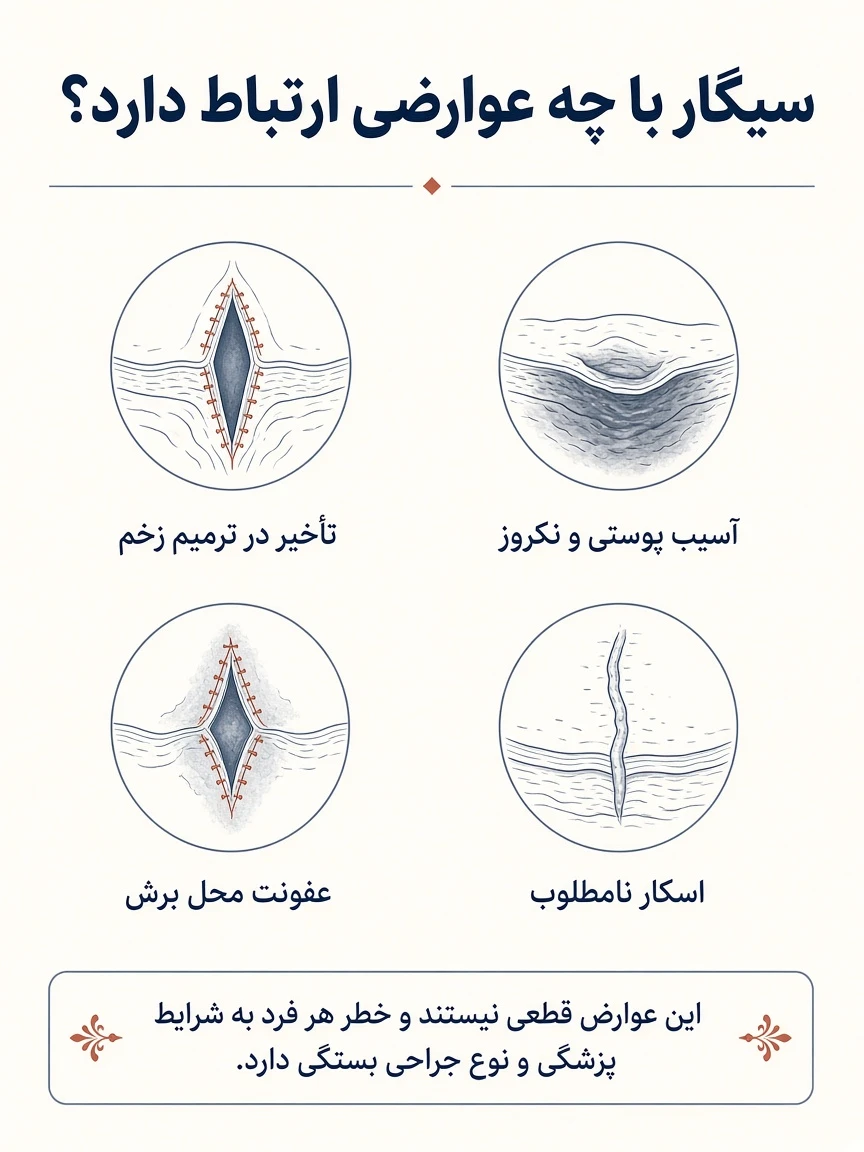
The problems discussed most often in this context are slower incision closure, superficial or deeper injury of undermined skin (including necrosis in more severe cases), incision infection, and a scar that stays darker or firmer because healing was uneven.
Hematoma has its own causes, including blood pressure and some medicines. This page does not attribute it to smoking. None of the healing problems above occur only in smokers. Quitting does not bring risk to zero. A general account of complications is in facelift risks and complications. Smoking is also part of facelift candidacy; this page does not replace that guide.
How long before a facelift should smoking stop?
These sources do not support one deadline for everyone. They support a range in which benefit is clearer, and they leave the date to the surgeon.
Mills’s review of trials found that preoperative cessation was associated with fewer postoperative complications, with a larger effect when cessation lasted at least four weeks. Wong’s review found fewer wound-healing complications when abstinence was longer than three to four weeks, compared with continued smoking. For respiratory complications, risk was lower after more than four weeks, and lower still after more than eight weeks. Abstinence shorter than four weeks neither clearly raised nor clearly lowered respiratory risk in that review. Stopping only the night before does not replace a plan of several weeks, and the evidence does not say that every shorter quit increases risk.
In plastic surgery, Pluvy and colleagues summarized the literature as about three to eight weeks before surgery and up to about four weeks afterward. Their own proposal was four weeks before surgery, continued until primary healing, which they placed at about two weeks. That is a synthesis, not a rule for every operation.
The 2024 ASPS practice reference says preoperative cessation should, depending on health and the procedure, be four to eight weeks before surgery unless there is an urgent clinical reason to operate sooner. It suggests continued avoidance for at least about four weeks after surgery.
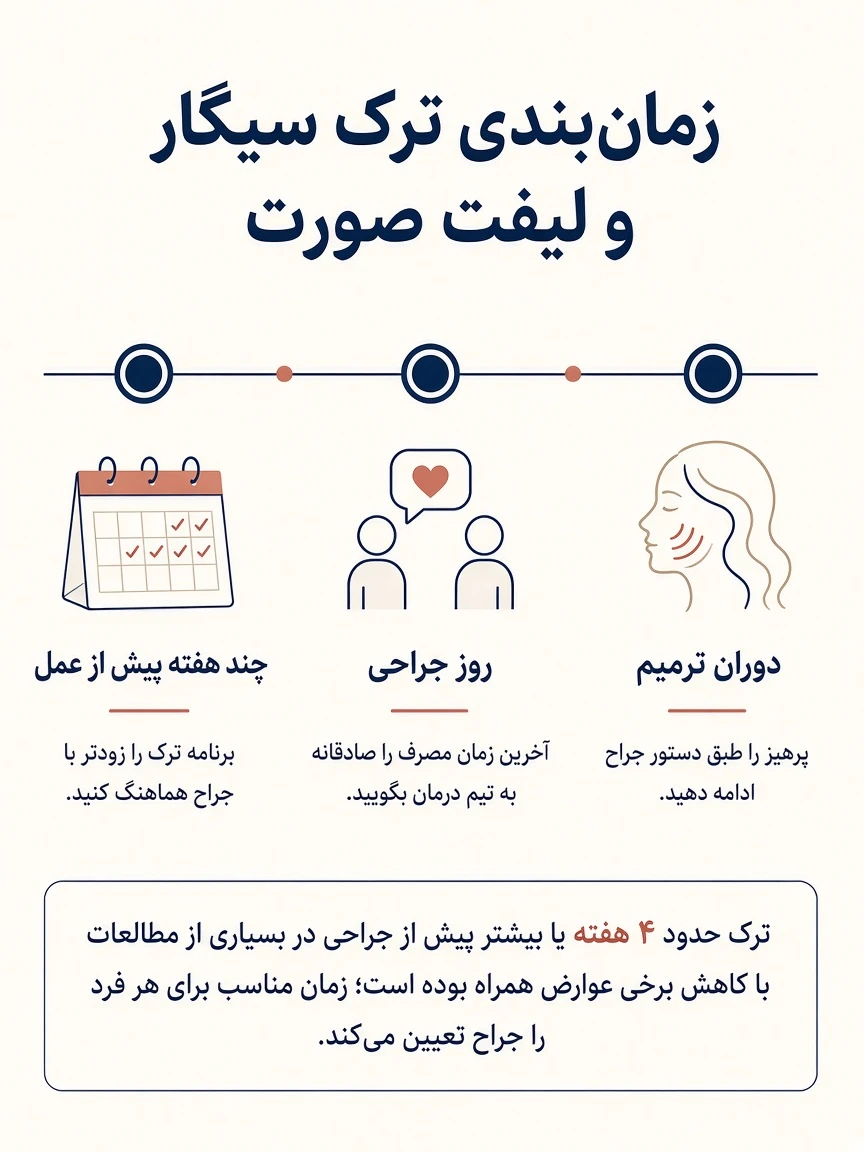
“Four weeks” and “six weeks” are common intervals drawn from this kind of evidence. The extent of the lift, skin quality, medical conditions, and how much the person uses all affect the surgeon’s decision. The broader task list is in preparing for facelift surgery. Do not treat one fixed number on that list as your personal nicotine plan.
Are vapes and e-cigarettes a problem before a facelift?
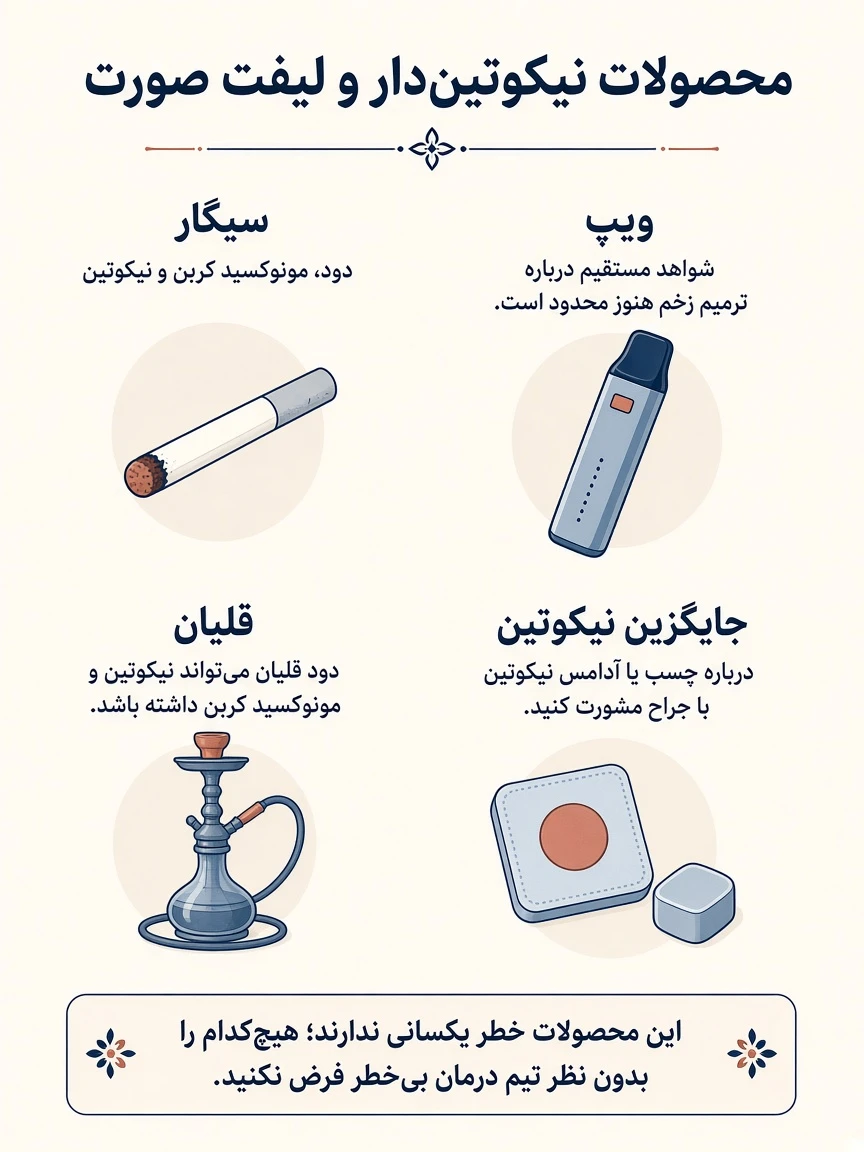
A vape should not be treated as safe merely because it does not produce ordinary cigarette smoke. Direct clinical evidence on vaping and wound healing is still limited, so equivalence with cigarettes is not proven either.
A 2023 systematic review of vaping and surgical wound healing found objective clinical data insufficient and, with that limitation, recommended treating e-cigarettes like tobacco in the perioperative period and stopping them. The authors said clinical trials are still needed.
The 2024 ASPS reference likewise notes the lack of e-cigarette-specific clinical data, while stating that nicotine reduces blood flow, so vaping is a potential risk. Until more evidence exists, it suggests considering a similar cessation interval for e-cigarettes and other nicotine forms. Taub and Matarasso, as summarized by ASPS, call stopping e-cigarettes about four weeks before plastic surgery a prudent course, and they state that it has not been shown that vaporized nicotine has the same effect as cigarettes.
The practical difference is that a cigarette adds carbon monoxide and combustion products to nicotine. A vape usually lacks that combustion, but a nicotine-containing liquid still delivers a vasoconstrictor. Other aerosol constituents have been studied mainly in cells and animals, not in facelift patients.
Nicotine-free vaping is not proven harmless. The 2023 review included laboratory and animal work on e-cigarette extract and did not provide a separate clinical result for nicotine-free liquid in facial surgery. Until that evidence exists, assuming safety is not justified. Tell the surgical team the device, the liquid, and the last use.
What about hookah, nicotine, and cigarette substitutes?
These products do not share one risk profile.
Hookah smoke comes from burning tobacco material and delivers nicotine and carbon monoxide. The sources used here do not include a hookah-specific facelift trial. Clinically, hookah belongs with smoke and nicotine exposure and should be disclosed as smoking is. Not being a paper cigarette is not a reason to continue.
Patches, gum, and other nicotine-replacement products are not identical to cigarettes. Sørensen’s mechanistic review concluded that nicotine, unlike whole smoke, does not disrupt the tissue oxygen environment in the same way, and that its effect on inflammation and cell proliferation looked marginal in the studies reviewed. A replacement product is therefore not biologically the same as smoking.
Safety in surgery that depends on skin blood flow is still not established. The 2024 reference asks surgeons to ask about every nicotine form, including patches and vaping, and, until more evidence exists, to consider a similar avoidance interval. If you need a patch or gum in order to stop, say so before surgery. Stopping abruptly with no plan is not automatically better if it leads back to cigarettes in the days before the operation. That balance belongs to the treating team.
When can smoking or vaping restart after a facelift?
These sources do not give a universally safe restart date. The weeks after surgery are when the incision closes and the lifted skin has to keep its blood supply. Returning to cigarettes or vaping in that window can bring vasoconstriction and lower oxygen back into healing.
The ASPS reference suggests continued avoidance of cigarettes and nicotine for at least about four weeks after surgery. Pluvy’s proposal was to continue until primary healing, about two weeks, while the literature they reviewed also mentioned up to about four weeks after surgery. That spread is itself a reason not to treat one calendar day as universally safe.
If healing is slow, or a wound edge darkens or drains, four weeks may be too short for that person. This page does not claim that restarting after a given date has no effect. General care in this period is covered in facelift recovery. Ask your own surgeon about cigarettes and vaping; do not copy a date from the general recovery guide.
What if I smoked close to the operation?
Tell the surgical team. Concealing use leaves anesthesia and surgery decisions on incomplete information.
Say what was used (cigarettes, vape, hookah, patch, gum, or a combination), roughly when the last use was, whether recent use was regular or a single occasion, and, for a vape, whether the liquid contained nicotine. If you are unsure, say that.
Then follow the team’s instructions. The operation may stay on the planned day, it may be postponed, and another check may be requested. The 2024 reference lists a urine nicotine or cotinine test as something a surgeon may consider the day before or the day of surgery. It is not a requirement of every center.
Do not decide by yourself that the operation must be cancelled, and do not decide that a small amount was not worth mentioning.
Summary
Smoking makes healing after a facelift harder by lowering tissue oxygen, affecting blood flow, and impairing collagen formation, and it raises the chance of some skin and wound complications. Vaping, hookah, and nicotine products should not be assumed safe, even where the evidence is thinner than for cigarettes. Published intervals are usually several weeks before surgery and continued avoidance during early healing, but the surgeon sets the number for that person. If you have used nicotine close to surgery, do not hide it.
Before the date is finalized, tell the surgeon about current or recent use and agree a cessation plan. The rest of the preoperative tasks are in preparing for facelift surgery.
References
1. Sørensen LT. Wound healing and infection in surgery: the pathophysiological impact of smoking, smoking cessation, and nicotine replacement therapy: a systematic review. Ann Surg. 2012;255(6):1069-1079. 2. Sørensen LT. Wound healing and infection in surgery. The clinical impact of smoking and smoking cessation: a systematic review and meta-analysis. Arch Surg. 2012;147(4):373-383. 3. Mills E, Eyawo O, Lockhart I, Kelly S, Wu P, Ebbert JO. Smoking cessation reduces postoperative complications: a systematic review and meta-analysis. Am J Med. 2011;124(2):144-154. 4. Wong J, Lam DP, Abrishami A, Chan MTV, Chung F. Short-term preoperative smoking cessation and postoperative complications: a systematic review and meta-analysis. Can J Anaesth. 2012;59(3):268-279. 5. Pluvy I, et al. Smoking and plastic surgery, part I. Pathophysiological aspects: update and proposed recommendations. Ann Chir Plast Esthet. 2015. 6. Pluvy I, et al. Smoking and plastic surgery, part II. Clinical implications: a systematic review with meta-analysis. Ann Chir Plast Esthet. 2015;60(1):e15-e49. 7. Rees TD, Liverett DM, Guy CL. The effect of cigarette smoking on skin-flap survival in the face lift patient. Plast Reconstr Surg. 1984;73(6):911-915. 8. American Society of Plastic Surgeons. Managing the Risks of Smoking in Plastic Surgery Patients. Practice reference, 2024. 9. American Society of Plastic Surgeons. Patients should stop using e-cigarettes before plastic surgery, experts conclude. Summary of Taub and Matarasso. 10. The implications of vaping on surgical wound healing: a systematic review. Surgery. 2023.
Frequently Asked Questions
Does a single cigarette before a facelift matter?
One exposure can briefly narrow blood vessels and add carbon monoxide, so it is worth reporting. It is not the same as daily smoking, and it does not by itself prove the operation must be cancelled. Tell the team what was used, when, and how much, and let them decide.
Is nicotine-free vaping safe before surgery?
It has not been shown to be safe. The 2023 review lacked sufficient clinical data and did not report a separate result for nicotine-free liquid in facial surgery. Do not assume it is harmless, and tell the surgeon what the liquid contains.
Should hookah also be stopped before a facelift?
Hookah delivers tobacco smoke, nicotine, and carbon monoxide. These sources do not include a hookah-specific facelift trial, but clinically it belongs with smoke and nicotine exposure and should be discussed as smoking is. The stop date is individual.
What is the risk if I smoke again after surgery?
The first weeks are when the incision and the lifted skin depend on blood flow. Returning to cigarettes or vaping can bring vasoconstriction and lower oxygen back into healing. ASPS suggests at least about four weeks of avoidance after surgery, but there is no universally safe restart date. It depends on healing and the surgeon.
Are nicotine patches or gum allowed before surgery?
There is no single yes or no for everyone. Mechanistically, nicotine replacement is not the same as cigarette smoke, and Sørensen described its effect on the healing pathways reviewed as marginal. Safety for facelift skin blood flow is still not established, and ASPS suggests considering a similar avoidance interval for other nicotine forms until more evidence exists. If you need a patch or gum to quit, discuss it before surgery. Do not hide it.